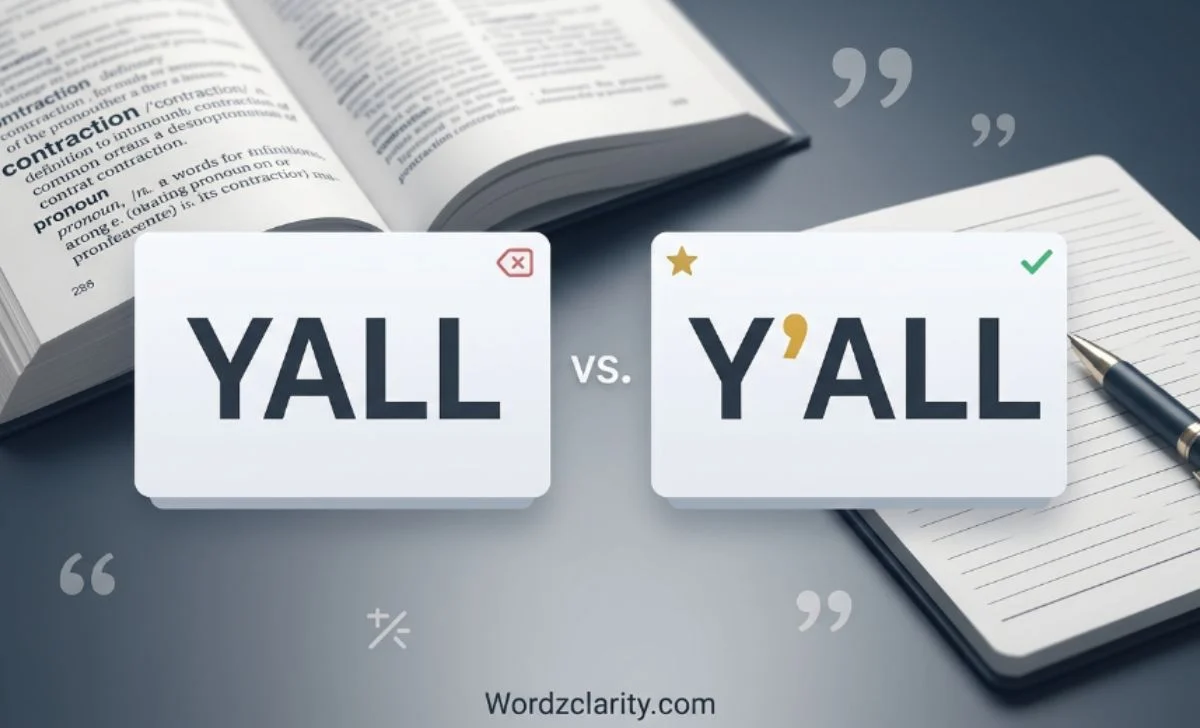
Have you ever typed “yall” and wondered whether it should have an apostrophe? You are not alone. The two forms look almost identical, but they do not have the same status in standard written English.
The correct spelling is “y’all.” It is a contraction of “you all” and is commonly used as an informal way to address two or more people. The apostrophe shows that letters have been left out when the two words are shortened.
You may still see “yall” without an apostrophe in text messages, social media posts, usernames, and other casual writing. However, that does not make it the standard spelling.
In this guide, you will learn the difference between yall and y’all, why the apostrophe matters, how to use y’all correctly, when it is appropriate, common mistakes to avoid, and how it compares with alternatives such as you all and you guys.
Quick Answer: Is It Yall or Y’all?
Y’all is the standard spelling.
It is a contraction of “you all.” The apostrophe replaces the letters removed from you all when the phrase is shortened.
- Correct: Y’all are welcome here.
- Correct: Are y’all ready?
- Correct: I hope y’all have a great weekend.
- Informal/nonstandard: Yall are welcome here.
The form “yall” without an apostrophe is widely seen online, especially in very casual writing. However, if you want to follow standard written English, use “y’all.”
| Form | Status | Meaning |
|---|---|---|
| y’all | Standard informal contraction | You all |
| yall | Common informal/nonstandard form | You all |
| you all | Standard | You all |
| you guys | Informal alternative | A group being addressed |
A simple rule is:
When you mean “you all,” write “y’all” in informal writing.
What Does “Y’all” Mean?
Y’all means “you all.”
It is a second-person pronoun used when speaking to or addressing a group of people.
For example:
Y’all should come over tomorrow.
This means:
You all should come over tomorrow.
Another example is:
Are y’all coming to the meeting?
This means:
Are you all coming to the meeting?
One useful feature of y’all is that it clearly addresses multiple people. English often uses “you” for both one person and several people, so y’all can make the plural meaning clearer.
Compare these sentences:
- Are you coming? — Could mean one person or several people.
- Are y’all coming? — Clearly addresses more than one person.
This makes y’all especially useful in conversational English.
Why Does “Y’all” Have an Apostrophe?
The apostrophe in y’all represents missing letters.
The phrase starts as:
you all
When it becomes a contraction, it is shortened to:
y’all
The apostrophe marks the place where letters have been removed.
This is similar to other common contractions:
| Full form | Contraction |
|---|---|
| do not | don’t |
| cannot | can’t |
| I am | I’m |
| we are | we’re |
| they are | they’re |
| you are | you’re |
| you all | y’all |
The apostrophe is therefore not decorative. It shows that y’all is a shortened form of you all.
That is why “yall” is not the standard spelling. Without the apostrophe, the word no longer clearly follows the normal contraction pattern.
Is “Yall” Wrong?
It depends on the context.
In standard edited English, “yall” is generally considered a nonstandard spelling of “y’all.” However, it is common in informal digital communication.
You may encounter yall in:
- Text messages
- Social media posts
- Online comments
- Chat messages
- Usernames
- Search queries
- Informal captions
For example:
Yall need to see this!
People will usually understand what the writer means. The missing apostrophe does not normally create a communication problem.
Still, if you are writing something that should follow standard English conventions, y’all is the better choice.
For example, use y’all in an informal email, article, blog post, or dialogue when the word fits the tone.
For formal academic or professional writing, however, you all may be more appropriate.
Y’all vs. You All
Both y’all and you all can be correct.
The main difference is style.
You all is the complete phrase. Y’all is the contraction.
Compare:
You all did a great job.
Y’all did a great job.
Both sentences communicate the same basic meaning.
The first sounds more neutral or deliberate. The second sounds more conversational.
| Feature | Y’all | You all |
|---|---|---|
| Meaning | You all | You all |
| Form | Contraction | Full phrase |
| Tone | Informal/conversational | Neutral |
| Apostrophe | Yes | No |
| Common in speech | Very common | Common |
| Suitable for formal writing | Sometimes, depending on context | Usually safer |
If you are writing dialogue or trying to sound natural and conversational, y’all can work very well.
If you are writing a formal academic paper, you all may still be too conversational in many contexts. In that case, simply addressing the group as you or restructuring the sentence may be better.
Is “Y’all” Singular or Plural?
Y’all is generally plural.
It normally refers to two or more people.
For example:
Y’all should take your seats.
The speaker is addressing a group.
However, regional speech can be more complicated. In some varieties of Southern American English, speakers may use y’all in ways that can sometimes refer to a single person, especially in certain expressions or situations. This is not the usual general-purpose rule for learners.
For standard usage advice, it is safest to remember:
Y’all = you all = a group of people.
For example:
Are y’all ready?
This naturally means:
Are all of you ready?
Where Is “Y’all” Used?
Y’all is strongly associated with American English, especially the Southern United States and other regions influenced by Southern speech.
Over time, however, its use has spread far beyond the American South.
Today, you can see y’all in many types of informal communication, including:
- Everyday conversation
- Text messages
- Social media
- Online communities
- Marketing
- Customer communication
- Blogs
- Casual emails
- Entertainment
- Dialogue in books and television
Its wider use is partly connected to its usefulness. English does not have a separate standard second-person plural pronoun in most varieties, so y’all provides a convenient way to address a group.
For example:
Thank y’all for joining us.
This can sound friendly and inclusive.
Is “Y’all” Only a Southern Word?
No.
Y’all has strong Southern American roots and associations, but it is not limited to the South.
It has become increasingly common in informal American English across different regions. It is also frequently used online by people who do not live in the American South.
Social media has helped make the expression familiar to a much wider audience.
Still, y’all can carry a regional or conversational flavor. The exact impression depends on the speaker, audience, and context.
For example:
Y’all have a great day!
may sound warm and friendly.
In a formal legal document, the same word would probably feel out of place.
The important point is that y’all is not incorrect simply because it is associated with a particular region. It is a recognized informal English expression.
Common Examples of “Y’all”
Here are natural examples of y’all in everyday English.
In conversation
Are y’all ready to leave?
What are y’all doing tonight?
I’ll see y’all tomorrow.
In text messages
Y’all want to grab dinner?
Hope y’all got home safely.
Thanks, y’all!
On social media
Y’all need to try this recipe.
Thank y’all for all the support!
What do y’all think?
In an informal email
Hi everyone, I hope y’all are doing well.
This can be appropriate when the relationship and workplace culture are informal.
In business communication
We appreciate y’all taking the time to attend the event.
This is grammatically understandable, but whether it is appropriate depends heavily on the company’s tone and audience. A more neutral version would be:
We appreciate you all taking the time to attend the event.
In academic writing
The survey asked whether y’all had encountered the issue before.
This would normally sound too conversational for academic prose unless the writer is intentionally representing spoken language or quoting a particular style of speech.
In dialogue
“Y’all coming with us?”
This works naturally when the character’s speech is informal.
Y’all in Professional Writing
Whether you should use y’all at work depends on the audience and the tone you want.
There is no universal rule saying that the word can never appear in professional communication. However, formal writing usually favors more neutral language.
For example:
Informal:
Thanks, y’all, for helping with the project.
More neutral:
Thank you all for helping with the project.
Very formal:
Thank you for your assistance with the project.
All three can be grammatically sound, but they create different impressions.
Use y’all when the communication is intentionally friendly, relaxed, or conversational.
Use you all when you want to address a group while keeping the language relatively neutral.
For highly formal writing, you may want to avoid both expressions and simply use you or name the group.
Y’all in Academic Writing
Academic writing generally values a formal and objective tone.
Because y’all is informal and conversational, it is not normally the best choice for essays, research papers, dissertations, or formal academic reports.
For example, instead of:
Y’all can see from these results that the theory is supported.
A more academic sentence would be:
These results support the theory.
This removes the conversational phrase completely.
However, y’all can appear in academic writing when the word itself is the subject of discussion.
For example:
The study examines the use of “y’all” in American English.
It can also appear when researchers are representing spoken language or quoting a participant.
The key is to distinguish between using the word and talking about the word.
Common Mistakes With “Y’all”
Several mistakes appear frequently when people write y’all.
1. Writing “yall”
The most common issue is leaving out the apostrophe.
Incorrect/nonstandard: Yall are late.
Standard: Y’all are late.
Remember that y’all is a contraction of you all, so the apostrophe matters.
2. Writing “ya’ll”
Another common mistake is putting the apostrophe in the wrong position.
Incorrect: ya’ll
Correct: y’all
The apostrophe should appear after y, because it represents the letters removed from you.
3. Confusing “y’all” with “your”
Y’all means you all.
Your shows possession.
Compare:
Y’all should bring your books.
Here, y’all refers to the people, while your shows that the books belong to them.
4. Confusing “y’all” with “you’re”
You’re means you are.
Y’all means you all.
Compare:
You’re ready.
= You are ready.
Y’all are ready.
= You all are ready.
These words have completely different meanings.
5. Using “y’all’s” too freely
You may see y’all’s in informal English as a possessive form.
For example:
Is this y’all’s car?
This means:
Is this your group’s car?
It is common in some varieties of American English, but it is strongly informal. In formal writing, your, your group’s, or a similar construction is usually better.
Y’all vs. Yall vs. Ya’ll
These three forms are often confused.
| Form | Recommended? | Explanation |
|---|---|---|
| y’all | Yes | Standard spelling of the contraction |
| yall | No for standard writing | Common informal spelling without apostrophe |
| ya’ll | No | Apostrophe is placed incorrectly |
The easiest way to remember the correct form is to start with you all:
you all → y’all
The apostrophe goes after y.
Should You Use “Y’all” or “You Guys”?
Both can be informal ways to address a group, but they have different styles.
Y’all is a concise way to mean you all.
You guys is another common informal plural expression in American English.
For example:
Y’all did a great job.
You guys did a great job.
Both can refer to a group.
However, y’all can be useful when you want a clear plural form without using the word guys.
It can also sound warm, friendly, and inclusive.
The best choice depends on your audience and the tone of your writing.
How to Remember the Correct Spelling
Use this simple memory trick:
Y’all = you all
If you can expand y’all to you all, the apostrophe makes sense.
For example:
Y’all are invited.
Expand it:
You all are invited.
Another example:
I hope y’all enjoy the show.
Expand it:
I hope you all enjoy the show.
This trick also helps you avoid ya’ll.
Remember:
you all → y’all
Not:
you all → ya’ll
Is “Y’all” Acceptable in Scrabble, Word Games, or Dictionaries?
Whether y’all is accepted in a particular word game depends on that game’s official dictionary and rules. Contractions are often treated differently from ordinary dictionary entries in word games.
For general English, however, y’all is an established informal expression and appears in dictionaries and linguistic references.
If your concern is ordinary writing rather than a specific word game, the practical answer is simple:
Use “y’all” when you want the informal contraction of “you all.”
Should “Y’all” Be Capitalized?
Y’all follows normal capitalization rules.
At the beginning of a sentence:
Y’all are welcome to join us.
In the middle of a sentence:
I hope y’all can come.
It does not normally need a capital letter simply because it is y’all.
The apostrophe remains in both forms:
- Y’all at the beginning of a sentence
- y’all elsewhere
Is “Y’all” Formal or Informal?
Y’all is generally informal.
It is especially natural in:
- Conversation
- Text messages
- Social media
- Casual emails
- Friendly announcements
- Dialogue
- Informal online writing
It may be less suitable in:
- Academic papers
- Legal documents
- Formal reports
- Highly formal business writing
- Official correspondence
That does not mean y’all is grammatically wrong. It means its register is conversational.
Good writing is not just about grammar. It is also about choosing language that fits the situation.
Y’all in Modern Online English
The internet has helped y’all become much more visible outside its traditional regional associations.
You can find it in social media posts, comments, online communities, newsletters, marketing messages, and casual digital conversations.
One reason it works well online is that it is short and clear.
Compare:
You all should check this out.
with:
Y’all should check this out.
The second version is shorter and has a more conversational feel.
The spelling yall also appears online because people often leave out apostrophes when typing quickly. That usage is easy to understand, but it does not replace the standard spelling y’all.
A Practical Comparison
The following table summarizes the main differences.
| Word or phrase | Meaning | Style | Standard spelling? |
|---|---|---|---|
| y’all | You all | Informal | Yes |
| yall | You all | Very informal/nonstandard | No |
| ya’ll | Intended as you all | Informal | No |
| you all | You all | Neutral/informal | Yes |
| you guys | A group | Informal | Yes |
The best choice depends on the audience.
Quick Tips for Using “Y’all” Correctly
Keep these points in mind:
- Use “y’all” for “you all.”
- Keep the apostrophe after the y.
- Do not write “ya’ll.”
- “Yall” is common online but is not the standard spelling.
- Use “y’all” mainly in informal or conversational contexts.
- Use “you all” when you want the complete phrase.
- Avoid “y’all” in formal writing unless the context calls for it.
- Do not confuse “y’all” with “your” or “you’re.”
- Remember that “y’all” normally refers to a group.
- Let your audience and writing style guide your choice.
FAQs
1. Is “yall” or “y’all” correct?
Y’all is the standard spelling. It is a contraction of you all. Yall without the apostrophe is common in casual online writing but is not the standard form.
2. Why does y’all have an apostrophe?
The apostrophe shows that letters have been omitted from you all when the phrase is shortened to y’all.
3. Is “ya’ll” correct?
No. Ya’ll is a common misspelling. The standard form is y’all, with the apostrophe after the y.
4. Is y’all grammatically correct?
Yes. Y’all is an established informal contraction of you all. It is grammatically appropriate in contexts where informal language is suitable.
5. Is y’all singular or plural?
Y’all is normally plural, meaning you all. It is generally used when addressing two or more people.
6. Can I use y’all in formal writing?
You can, but it is usually better to avoid it in highly formal writing. You all or a more neutral sentence structure may be more appropriate.
7. Is y’all only used in Southern American English?
No. It has strong associations with Southern American English, but its use has spread to many other parts of the United States and is common in online communication.
Conclusion
When choosing between yall or y’all, the standard form is y’all. It is an informal contraction of you all, and the apostrophe shows that letters have been removed from the original phrase.
The form yall is easy to understand and appears frequently in texts, social media posts, comments, and other casual online communication. However, if you want to follow standard English spelling, keep the apostrophe.
It is also important to match the word to your audience. Y’all works naturally in conversation, friendly messages, informal emails, social media, and dialogue. In academic, legal, or highly formal writing, a neutral alternative such as you all or a completely rephrased sentence may be better.
The easiest rule to remember is simple: you all → y’all. Put the apostrophe after the y, not after ya. Once you remember that pattern, the difference between yall, y’all, and ya’ll becomes much easier to manage.
Read More Blogs:
- Passed Away or Past Away? Understanding the Correct Expression
- Effect or Affect: What’s the Difference and How Do You Use Them?
- To or Too: The Simple Difference You Need to Know