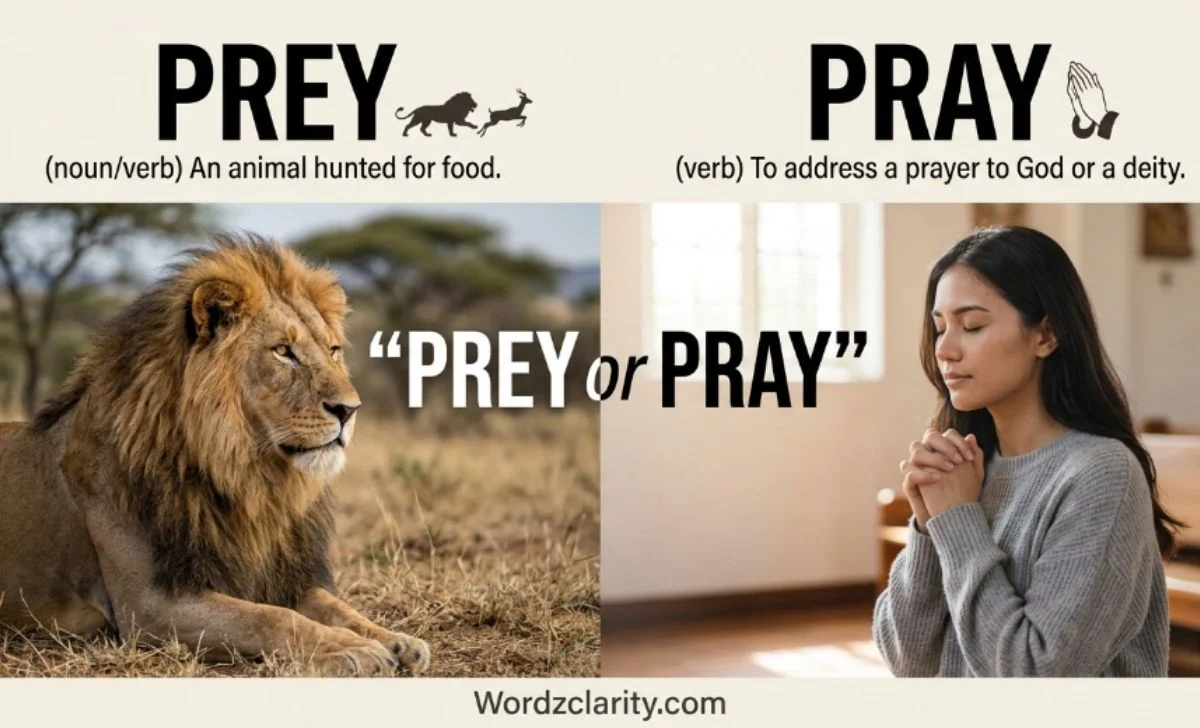
The English words prey and pray sound the same, but they have completely different meanings. This makes them easy to confuse, especially when you hear them in conversation and need to choose the correct spelling when writing.
One word is connected with animals, predators, hunting, and targets. The other is connected with prayer, worship, faith, and asking God for help. A single letter changes the meaning of the word entirely.
So, should you write prey or pray? The answer depends on what you mean.
In this guide, you will learn the difference between prey and pray, their meanings, pronunciation, parts of speech, Urdu meanings, sentence examples, common mistakes, and an easy way to remember which spelling to use. You will also see how these homophones work in everyday English, academic writing, business communication, news, websites, and social media.
Quick Answer: Prey vs. Pray
Prey refers to an animal hunted or captured by a predator. It can also describe a person or group that is targeted, exploited, or deceived.
Pray means to speak to God or another deity as part of worship. It can also mean to make a serious or urgent request.
| Word | Meaning | Part of Speech | Example |
|---|---|---|---|
| Prey | An animal hunted by another animal; a target or victim | Noun / Verb | The lion chased its prey. |
| Pray | To speak to God or make an earnest request | Verb | They pray for peace. |
Simple memory trick
Think of prey as something a predator hunts.
Think of pray as something you do when you pray to God.
For example:
- The eagle caught its prey.
- We pray for a better future.
The words sound alike, but their meanings are completely different.
What Does Prey Mean?
Prey is mainly used for an animal that is hunted and eaten by another animal. In the food chain, a predator hunts its prey to survive.
For example, a lion may hunt a zebra, so the zebra is the lion’s prey.
Common examples of prey include:
- Rabbits
- Deer
- Mice
- Fish
- Birds
- Insects
- Smaller mammals
The word can also be used when describing a person or group that is targeted because of a particular situation or circumstance.
For example:
Scammers often look for easy prey.
Here, prey does not mean an animal. It refers to a target that can be easily deceived or exploited.
Prey as a noun
The most common use of prey is as a noun.
Examples:
- The snake swallowed its prey.
- The hawk spotted its prey from above.
- The tiger waited patiently for its prey.
- The spider caught its prey in its web.
- The fox searched for prey at night.
Prey as a verb
Prey can also be a verb. When someone or something preys on another person, animal, or group, it targets or exploits them.
Examples:
- Wolves prey on smaller animals.
- Criminals prey on people who are easier to target.
- Some companies prey on customers who do not understand the contract.
- The disease can prey on a weakened organism.
The phrase prey on is especially important in everyday English.
For example:
Online scammers prey on people who are unfamiliar with digital security.
What Does Pray Mean?
Pray is a verb associated with prayer, worship, religion, faith, and communication with God or a deity.
When people pray, they may express gratitude, ask for help, seek guidance, or ask for forgiveness.
Examples:
- We pray for peace.
- She prays every morning.
- They went to church to pray.
- He prayed for his family.
- Many people pray before a difficult decision.
The word can also be used outside a strictly religious context to mean ask earnestly or urgently.
For example:
I pray that everything works out.
In older or formal English, pray can also introduce a polite request. However, this use is less common in modern everyday English.
Prey and Pray in Urdu
For Urdu-speaking English learners, the difference becomes easier when you connect each word with its Urdu meaning.
Prey Meaning in Urdu
Prey can mean:
- شکار
- شکار ہونے والا جانور
- نشانہ
- آسان شکار
For example:
The lion attacked its prey.
Urdu: شیر نے اپنے شکار پر حملہ کیا۔
When prey refers to a target, it can describe someone or something that becomes an easy target for another party.
Pray Meaning in Urdu
Pray can mean:
- دعا کرنا
- عبادت کرنا
- خدا سے دعا مانگنا
- التجا کرنا
For example:
We pray for your success.
Urdu: ہم آپ کی کامیابی کے لیے دعا کرتے ہیں۔
Another example:
She prays to God every day.
Urdu: وہ ہر روز خدا سے دعا کرتی ہے۔
Prey or Pray in Urdu: The Easy Difference
The easiest way to remember the Urdu difference is:
Prey = شکار
Pray = دعا کرنا
If you are talking about hunting, predators, animals, or a target, use prey.
If you are talking about God, prayer, worship, or asking for divine help, use pray.
Are Prey and Pray Homophones?
Yes. Prey and pray are homophones.
Homophones are words that have the same pronunciation but different meanings and spellings.
For example:
- prey / pray
- see / sea
- right / write
- flower / flour
- pair / pear
Because prey and pray sound the same, you cannot always know which word someone means simply by hearing it. You need to understand the context.
Compare these sentences:
The eagle caught its prey.
The family decided to pray together.
When spoken aloud, the two words sound the same. When written, however, their meanings are immediately clear.
Prey vs. Pray Pronunciation
Prey and pray have the same standard pronunciation in English.
Both are pronounced with the same long vowel sound found in words such as day and gray.
The important point is that pronunciation does not help you distinguish these two words. Context and spelling do.
For an English learner, this is why writing can be more difficult than speaking when using these words.
Prey vs. Pray: Detailed Comparison
| Feature | Prey | Pray |
|---|---|---|
| Basic meaning | An animal or target that is hunted or targeted | To speak to God or make an earnest request |
| Main association | Hunting and targets | Prayer and worship |
| Part of speech | Noun and verb | Verb |
| Pronunciation | Same as “pray” | Same as “prey” |
| Homophone | Yes | Yes |
| Common phrase | prey on | pray to |
| Urdu meaning | شکار، نشانہ | دعا کرنا، عبادت کرنا |
| Example | The owl caught its prey. | They pray for peace. |
The easiest distinction is:
Prey is something you hunt. Pray is something you do.
Prey: Common Phrases and Expressions
Learning common phrases can help you recognize prey in real writing.
Prey on
Prey on means to target or exploit someone or something that is easier to influence, attack, or deceive.
Examples:
- Criminals prey on people who may be easier to deceive.
- Predators prey on smaller animals.
- Fraudsters prey on people’s fears.
- Some businesses prey on customers who need quick solutions.
Easy prey
Easy prey describes someone or something that can be easily attacked, defeated, deceived, or exploited.
Examples:
- The injured animal became easy prey.
- New users may become easy prey for online scammers.
- The isolated village was easy prey for attackers.
Natural prey
Natural prey refers to animals that a predator normally hunts.
Example:
Rabbits are natural prey for many predators.
Pray: Common Phrases and Expressions
The word pray also appears in several common expressions.
Pray to God
This means to direct a prayer toward God.
Example:
She prayed to God for guidance.
Pray for
This means to ask God or a higher power for something.
Examples:
- We pray for peace.
- They prayed for his recovery.
- I pray for your success.
Pray that
This structure introduces something the speaker hopes will happen.
Examples:
- I pray that you are safe.
- We pray that the situation improves.
- She prayed that her family would remain well.
Pray tell
Pray tell is an old-fashioned or literary expression meaning please tell me.
Example:
Pray tell, what happened next?
This expression is much less common in modern everyday conversation.
Prey or Pray: Real-World Examples
Understanding how the words appear in different types of writing can make the distinction easier.
In everyday conversation
“The cat brought its prey into the house.”
“We should pray for them.”
The first sentence is about an animal being hunted. The second is about prayer.
In business writing
“Some dishonest companies prey on customers who are unfamiliar with financial terms.”
Here, prey on means exploit.
In a different context:
“We pray that our new project will benefit the community.”
Here, pray expresses a hope or religious request.
In academic writing
Prey is common in biology and ecology.
“The population of prey declined as the number of predators increased.”
In religious studies or social sciences, pray may appear when discussing religious practices.
“Members of the community gather to pray during the ceremony.”
In news writing
News articles may use prey when discussing crime or wildlife:
“Authorities warned that scammers were preying on people who could be easier targets.”
They may use pray when reporting on religious events:
“Thousands gathered to pray for peace.”
On websites and social media
You might see:
“Don’t become easy prey for online scams.”
Or:
“Please pray for everyone affected by the disaster.”
These examples show why context matters.
Common Mistakes With Prey and Pray
Because the words sound identical, spelling mistakes are common.
Mistake 1: “Pray” when you mean an animal
Incorrect:
The lion chased its pray.
Correct:
The lion chased its prey.
The lion is hunting, so prey is the correct word.
Mistake 2: “Prey” when you mean prayer
Incorrect:
We prey for your safety.
Correct:
We pray for your safety.
You are expressing a prayer, so pray is correct.
Mistake 3: “Prey to God”
Incorrect:
I prey to God every night.
Correct:
I pray to God every night.
When the meaning involves worship or speaking to God, use pray.
Mistake 4: “Pray on people”
Incorrect:
Criminals pray on people who may be easier to deceive.
Correct:
Criminals prey on people who may be easier to deceive.
The phrase prey on means to exploit or target someone.
How to Remember Prey vs. Pray
A simple memory trick can prevent most mistakes.
Remember the “E” in Prey
Think:
PrEy = Eat
An animal’s prey may be something a predator wants to eat.
This is not a formal spelling rule, but it is a useful memory aid.
Remember Pray and Prayer
Pray and prayer are closely connected.
If you can replace the word with pray for, pray to God, or offer a prayer, you need pray.
For example:
We ___ for peace.
The answer is pray.
But:
The wolf chased its ___.
The answer is prey.
Prey and Pray Sentence Examples
Here are more examples to reinforce the difference.
Examples with Prey
- The eagle watched its prey from the sky.
- The snake moved toward its prey.
- The lion attacked its prey.
- The owl hunts small prey at night.
- The injured deer became easy prey.
- Sharks can detect potential prey from a distance.
- Scammers often prey on people who may be easier to deceive.
- The fox was searching for prey.
- The hawk carried its prey away.
- Small animals can become prey for larger predators.
Examples with Pray
- We pray for peace.
- She prays every morning.
- They went to the mosque to pray.
- He prayed for his family.
- Many people pray during difficult times.
- I pray that everything goes well.
- They gathered to pray for the people affected by the disaster.
- She prayed to God for guidance.
- We should pray for those in need.
- He quietly prayed before making his decision.
Why Context Matters With These Homophones
When you hear prey or pray, you cannot depend on the sound to identify the word. You must look at the surrounding words.
Certain words provide strong clues.
Words that often appear with prey
- Predator
- Hunt
- Animal
- Capture
- Attack
- Wildlife
- Victim
- Target
- Food
- Chase
- Carnivore
- Ecosystem
Example:
The predator chased its prey.
The words predator and chased clearly point to prey.
Words that often appear with pray
- God
- Prayer
- Worship
- Faith
- Church
- Mosque
- Temple
- Blessing
- Peace
- Hope
- Guidance
- Devotion
Example:
They pray to God for guidance.
The religious context makes pray the obvious choice.
Is Prey a Noun or a Verb?
Prey can be both a noun and a verb.
As a noun:
The rabbit became the fox’s prey.
As a verb:
Foxes prey on rabbits.
The noun refers to the target, while the verb describes the act of targeting or exploiting.
Is Pray a Noun or a Verb?
Pray is primarily a verb.
Examples:
- They pray every day.
- She prayed for help.
- We pray for peace.
The related noun is prayer.
For example:
Her prayer was answered.
So remember:
pray = verb
prayer = noun
Is “Prey or Pray” a British vs. American Spelling Difference?
No. Prey and pray are not British and American spelling variants.
Both words are standard English words in both British English and American English.
The difference is not regional spelling. They have different meanings and different spellings, even though they are pronounced the same.
For example, both British and American writers would use:
The lion chased its prey.
And both would use:
They pray for peace.
Therefore, you should not choose prey or pray based on whether your audience uses British or American English. Choose the word that matches your intended meaning.
Prey or Pray: Which One Is Correct?
Both prey and pray are correct words. Neither spelling is a misspelling of the other.
Use prey when you mean:
- An animal hunted by another animal
- A target
- A victim
- To hunt or exploit someone or something
Use pray when you mean:
- To speak to God
- To worship
- To ask God for something
- To make an earnest request
Compare:
The lion found its prey.
The family gathered to pray.
Both sentences are correct because each word has a different meaning.
A Quick Test: Prey or Pray?
When you are unsure, ask yourself one question:
Is this sentence about hunting or prayer?
If it is about hunting, predators, animals, targets, or exploitation, choose prey.
If it is about God, worship, faith, or making an earnest request, choose pray.
Test 1
The wolf attacked its ___.
The answer is prey because the wolf is hunting.
Test 2
We ___ for your safety.
The answer is pray because the sentence refers to prayer.
Test 3
Criminals often ___ on people who may be easier to deceive.
The answer is prey because prey on means exploit or target.
Test 4
They ___ to God every evening.
The answer is pray because the sentence describes religious prayer.
FAQs
1. What is the difference between prey and pray?
Prey refers to an animal or target that is hunted, targeted, or exploited. Pray means to speak to God, worship, or make an earnest request.
2. Are prey and pray homophones?
Yes. Prey and pray are homophones because they have the same pronunciation but different spellings and meanings.
3. What is prey meaning in Urdu?
Prey generally means شکار، نشانہ، or شکار ہونے والا جانور in Urdu. It can refer to an animal hunted by a predator or a target.
4. What is pray meaning in Urdu?
Pray generally means دعا کرنا، عبادت کرنا، or خدا سے دعا مانگنا in Urdu.
5. How do you use prey in a sentence?
You can use prey for an animal or target that is hunted or targeted. For example: “The eagle caught its prey.” You can also use it as a verb: “Scammers prey on people who may be easier to deceive.”
6. How do you use pray in a sentence?
Use pray when talking about prayer, worship, or an earnest request. For example: “We pray for peace.”
7. Should I say “pray to God” or “prey to God”?
The correct phrase is “pray to God.” Use pray when referring to communication with or worship of God.
Conclusion
The difference between prey and pray is simple once you connect each word with its meaning. Prey relates to hunting, predators, targets, and victims, while pray relates to prayer, worship, God, faith, and earnest requests.
Both words are standard English words, and neither is a British or American spelling of the other. They are homophones, which means they sound the same but have different spellings and meanings. This is why context is so important.
Remember the basic rule: prey is hunted, while you pray. If a lion is chasing an animal, that animal is its prey. If someone is speaking to God or asking for divine help, they pray.
For Urdu learners, the distinction is equally useful: prey means شکار or نشانہ, while pray means دعا کرنا or عبادت کرنا. Keep these meanings in mind, and you will be able to choose the correct word confidently in conversations, emails, academic writing, news, and everyday English.
Read More Blogs:
- Steel or Steal: What Is the Difference?
- To or Too: The Simple Difference You Need to Know
- Effect or Affect: What’s the Difference and How Do You Use Them?
- Passed Away or Past Away? Understanding the Correct Expression