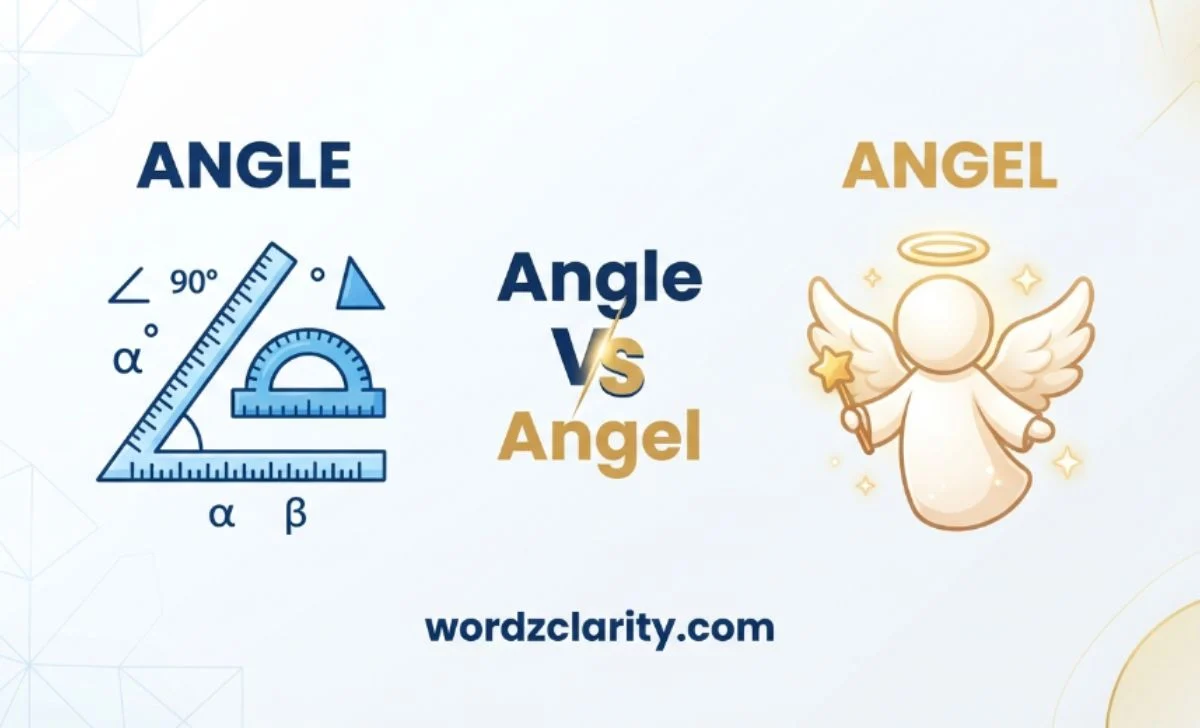
Have you ever typed “angel” when you meant “angle”? You’re not alone. These two words look similar, sound somewhat alike, and are among the most commonly confused words in English. A single misplaced letter can completely change the meaning of a sentence.
Imagine asking someone to “measure the angel” in a math class or talking about a “camera angel” in a photography guide , it instantly creates confusion.
The good news is that the difference is simple once you understand how each word is used. In this guide, you’ll learn the meaning of angle and angel, how to pronounce them correctly, why people mix them up, and when each word fits naturally in real-life situations.
By the end, you’ll know exactly which spelling to use whether you’re writing about geometry, photography, religion, or everyday conversations.
Quick Answer: Angle vs Angel
Although they differ by only one letter, angle and angel have completely different meanings.
- Angle refers to the space formed where two lines meet or to a particular point of view or direction.
- Angel refers to a spiritual being, a messenger of God in many religions, or a kind and caring person.
Simple rule to remember: If you’re talking about math, shapes, cameras, or viewpoints, use angle. If you’re talking about heaven, religion, or a kind person, use angel.
Angle vs Angel at a Glance
| Feature | Angle | Angel |
|---|---|---|
| Meaning | A shape formed by two intersecting lines or a viewpoint | A spiritual being or a very kind person |
| Part of Speech | Noun | Noun |
| Common Fields | Geometry, photography, architecture, writing | Religion, literature, everyday speech |
| Pronunciation | ANG-guhl (/ˈæŋɡəl/) | AYN-juhl (/ˈeɪndʒəl/) |
| Plural | Angles | Angels |
| Example | “The triangle has three angles.” | “She was an angel during my recovery.” |
Even though the spellings are close, the pronunciation and meaning clearly separate these words.
What Does “Angle” Mean?
The Meaning of Angle
An angle is the space created when two lines, rays, or edges meet at a common point. It is one of the basic concepts in geometry and appears everywhere—from school mathematics to engineering and architecture.
However, the word has another important meaning. In everyday English, angle can also describe a viewpoint, perspective, or approach to a subject.
Common uses of angle include:
- Mathematics
- Geometry
- Photography
- Film and video production
- Architecture
- Journalism
- Everyday conversations
Examples
- The teacher asked the students to measure the angle with a protractor.
- A right angle measures exactly 90 degrees.
- Try taking the picture from a lower angle for a more dramatic effect.
- The journalist covered the story from a different angle.
Notice how the meaning changes depending on the context, but it always relates to a position, direction, or point of view.
Angle in Different Contexts
Geometry
In mathematics, angles describe the relationship between two intersecting lines.
Some common types include:
- Acute angle
- Right angle
- Obtuse angle
- Straight angle
- Reflex angle
These terms are commonly taught in schools and are essential in subjects like mathematics, engineering, and technical drawing.
Photography and Film
Photographers frequently discuss camera angles because they influence how viewers experience an image.
For example:
- High-angle shot
- Low-angle shot
- Wide-angle lens
- Eye-level angle
Changing the camera angle can make a subject appear stronger, smaller, more dramatic, or more natural.
Everyday Communication
Outside technical fields, people often use angle to mean an idea or approach.
Examples:
- Let’s find a fresh angle for this marketing campaign.
- I hadn’t considered that angle before.
This figurative meaning is extremely common in business, journalism, and creative writing.
What Does “Angel” Mean?
The Meaning of Angel
An angel is generally understood as a spiritual being that serves as a messenger or servant of God in many religious traditions. The word appears frequently in religious texts, literature, art, and everyday speech.
Beyond religion, people also use angel to describe someone who is exceptionally kind, generous, patient, or helpful.
For example:
- My grandmother was an absolute angel.
- Thank you for helping me move , you’ve been an angel.
In these sentences, the word is used figuratively to praise someone’s kindness rather than describe a supernatural being.
Angel in Different Contexts
Religion
In Christianity and several other faiths, angels are believed to carry messages, offer guidance, and protect people.
Common expressions include:
- Guardian angel
- Angel of mercy
- Heavenly angel
- Archangel
These phrases are widely recognized in literature, religious discussions, and everyday language.
Literature and Popular Culture
Authors often use angels as symbols of hope, goodness, innocence, or protection.
You’ll also find the word in:
- Novels
- Movies
- Songs
- Paintings
- Holiday traditions
Everyday Speech
Many English speakers casually call a thoughtful or generous person an angel.
Examples:
- The nurse was an angel throughout my hospital stay.
- Thanks for babysitting at the last minute , you really are an angel.
In these examples, angel expresses appreciation rather than religious belief.
Pronunciation: Angle vs Angel
One reason these words are confused is that they look almost identical. However, their pronunciation is different enough to help you remember them.
| Word | IPA | Sounds Like |
|---|---|---|
| Angle | /ˈæŋɡəl/ | ANG-guhl |
| Angel | /ˈeɪndʒəl/ | AYN-juhl |
How to Hear the Difference
- Angle begins with the same “ang” sound heard in angry.
- Angel begins with the long “ayn” sound and includes the soft “j” sound found in gentle.
Reading both words aloud a few times is one of the quickest ways to avoid mixing them up while writing.
Why Do People Confuse Angle and Angel?
Despite their different meanings, these words are easy to confuse for several reasons.
Similar Spelling
Only two letters change, making them easy to mistype, especially when typing quickly.
Similar Appearance
At a quick glance, the brain often recognizes the overall word shape instead of every individual letter. That’s why proofreading matters.
Fast Typing
Many people accidentally type angel instead of angle, particularly on phones or small keyboards where nearby letters can be selected unintentionally.
English Learners
For people learning English as a second language, the pronunciation difference is not always obvious. Since both words are common, it’s easy to remember the wrong spelling.
Context Is Everything
The easiest way to choose the correct word is to ask yourself one simple question:
- Am I talking about shapes, measurements, viewpoints, or photography? → Angle
- Am I talking about heaven, kindness, or a spiritual being? → Angel
Once you focus on the context instead of the spelling, choosing the right word becomes much easier.
Origin of the Words: Angle vs Angel
At first glance, angle and angel seem closely related because of their spelling. In reality, they come from entirely different languages and developed with different meanings.
Where Does “Angle” Come From?
The word angle comes from the Latin word angulus, meaning corner or bend. As mathematics evolved, the term became the standard way to describe the space formed where two lines or rays meet.
Today, the word appears in many fields beyond geometry, including:
- Mathematics
- Architecture
- Engineering
- Physics
- Photography
- Journalism
- Business and marketing
Whether you’re measuring a triangle or discussing a new marketing angle, the idea of a position or perspective remains at the heart of the word.
Where Does “Angel” Come From?
The word angel has a very different history. It comes from the Greek word angelos, meaning messenger. The term later entered Latin and Old English before becoming the modern English word we use today.
In many religious traditions, an angel is viewed as a messenger or servant of God. Over time, English speakers also began using angel figuratively to describe someone who is exceptionally kind, patient, or generous.
Knowing these origins makes the difference easier to remember:
- Angle = corner or direction
- Angel = messenger or heavenly being
Grammar and Usage Rules
Although these words have different meanings, they share the same basic grammar.
Angle
Part of speech: Noun
Examples:
- The carpenter measured the angle carefully.
- Every triangle has three angles.
- We need a better angle for this news story.
Common Collocations
- Right angle
- Acute angle
- Obtuse angle
- Camera angle
- Viewing angle
- Wide-angle lens
- Different angle
- Best angle
Angel
Part of speech: Noun
Examples:
- The story mentions an angel bringing good news.
- She has always been my guardian angel.
- Thanks for helping me , you are an angel.
Common Collocations
- Guardian angel
- Fallen angel
- Archangel
- Angel wings
- Angel investor
- Angelic smile
Notice that angel investor is another common business term. It refers to a person who invests money in startups, not a religious figure.
Real-Life Examples
Learning through context is often more effective than memorizing definitions.
In School
✅ The teacher explained how to calculate the angle of the triangle.
❌ The teacher explained how to calculate the angel of the triangle.
In Photography
✅ Change the camera angle to capture more of the landscape.
❌ Change the camera angel to capture more of the landscape.
In Everyday Conversation
✅ You were an angel for helping me move house.
❌ You were an angle for helping me move house.
In Business
✅ Let’s approach the presentation from a different angle.
In Literature
✅ The novel describes an angel protecting the main character.
These examples show how context immediately tells you which word belongs in the sentence.
A Simple Memory Trick
If you struggle to remember the difference, use this quick association.
Remember “Angle”
Think of the letter L in angle as standing for Lines.
Lines meet to form an angle.
Remember “Angel”
Think of the letter E in angel as standing for Heaven or Eternal.
An angel is associated with heaven and kindness.
This simple trick works because it connects each word with its most common meaning instead of relying only on spelling.
Common Mistakes to Avoid
Many mistakes happen because people type too quickly or rely on autocorrect.
Here are some common examples.
| Incorrect | Correct |
|---|---|
| Measure the angel. | Measure the angle. |
| The camera angel looks amazing. | The camera angle looks amazing. |
| My angle helped me during difficult times. | My angel helped me during difficult times. |
| She is my guardian angle. | She is my guardian angel. |
A quick proofread is usually enough to catch these errors before publishing or sending a message.
Practice Sentences
Test yourself before moving on.
Choose angle or angel.
- The photographer changed the _____ to improve the shot.
- My grandmother always said her guardian _____ watched over her.
- Every square has four right _____.
- Everyone thanked the volunteer because she was an absolute _____.
- The reporter found a fresh _____ for the story.
Answers
- angle
- angel
- angles
- angel
- angle
If you answered all five correctly, you’ve mastered one of English’s most common spelling confusions.
FAQs
1. What is the difference between angle and angel?
An angle refers to a shape, direction, viewpoint, or measurement, while an angel is a spiritual being or a kind person. Although they look similar, they are unrelated in meaning.
2. Is it “camera angle” or “camera angel”?
The correct phrase is camera angle because it describes the position or perspective from which a photo or video is taken.
3. Is “guardian angle” correct?
No. The correct expression is guardian angel, referring to a protective spiritual being in many religious traditions.
4. Why are angle and angel often confused?
They differ by only one letter, and many people type quickly or overlook the spelling. Their similar appearance makes them a common typo, especially for English learners.
5. Are angle and angel pronounced the same?
No. Angle is pronounced ANG-guhl (/ˈæŋɡəl/), while angel is pronounced AYN-juhl (/ˈeɪndʒəl/).
6. Can “angle” mean something other than a geometric shape?
Yes. It can also mean a viewpoint, perspective, or approach, such as discussing a news angle or a marketing angle.
7. Can “angel” describe a person?
Yes. English speakers often call someone an angel to praise their kindness, patience, or generosity.
8. How can I remember the difference?
Think of angle as relating to lines and geometry, and angel as relating to heaven and kindness. Focusing on the context is the easiest way to choose the correct word.
Conclusion
The difference between angle and angel is easy to understand once you focus on the context instead of the spelling. Angle belongs to the world of geometry, photography, engineering, and perspectives, while angel belongs to religion, literature, and expressions of kindness.
Even though these words differ by just one letter, using the wrong one can change the meaning of your sentence completely.
The next time you write either word, pause for a moment and ask yourself what you’re describing. If it’s about a shape, direction, or point of view, choose angle.
If it’s about a heavenly messenger or a compassionate person, choose angel. That simple habit will help you use both words accurately and confidently in every situation.
Read More Blogs:
Seel vs Seal: Differences, Definitions, and How to Use Each Word
Is Ready or Not Cross-Platform? Everything You Need to Know
OR Nurse: Meaning, Duties, Skills, Salary, Career Path