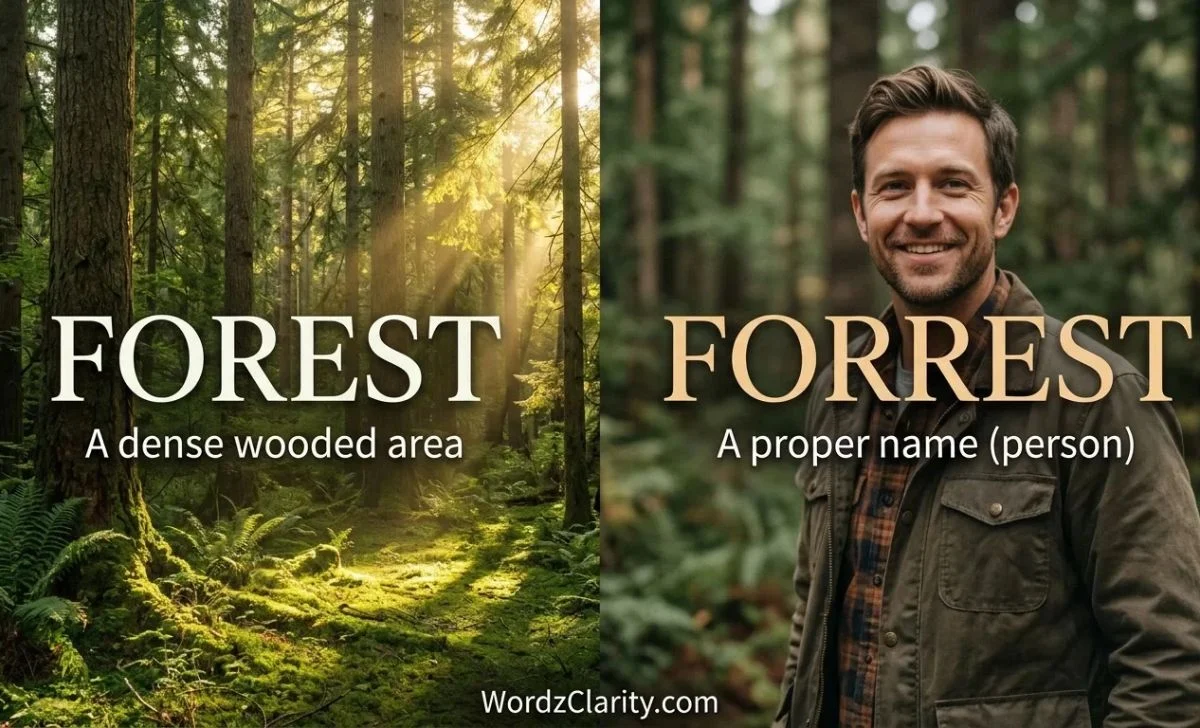
Forest is the correct spelling for a large area covered with trees. Forrest is a name. You use it for people, like Forrest Gump or Forrest Mars. You never use it for the woodland itself.
That is the short answer. The rest of this guide explains why the two get mixed up, and how to get it right every time.
Quick Answer:
| Forest | Forrest | |
|---|---|---|
| Part of speech | Common noun (also a verb) | Proper noun |
| Meaning | A large area covered with trees | A first name or surname |
| Capital letter? | Only at the start of a sentence | Always |
| Example | We hiked through the forest. | Forrest called me back. |
Write “forest” when you mean trees. Write “Forrest” when you mean a person.
What Does “Forest” Mean?
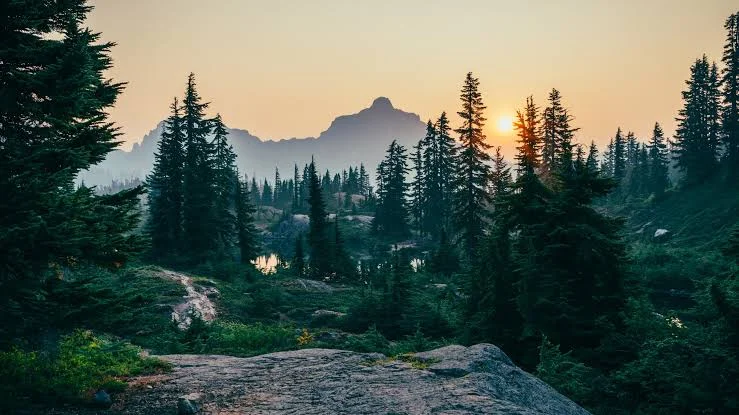
This is a best view of Forest.
A forest is a large area of land covered mostly by trees and undergrowth. The word works as a noun, and it can also work as a verb.
Here are some examples:
- The forest was silent after the snow.
- Rangers patrol the forest every morning.
- The council plans to forest the hillside with native oaks.
The verb use is rare. It means to plant an area with trees.
How Experts Define a Forest
Scientists use stricter rules than everyday speakers. The UN Food and Agriculture Organization defines a forest as land of more than 0.5 hectares, with trees taller than 5 metres and a canopy cover above 10 percent.
Its Global Forest Resources Assessment 2020 found that forests cover about 4.06 billion hectares worldwide.
So a few trees in your backyard are not a forest. Neither is a city park.
Why Do People Write “Forrest”?
Three things cause the mix-up.
The Name Is Everywhere
Most of us meet “Forrest” long before we study the spelling of “forest.” The film Forrest Gump made the double-r name famous. The brain stores the shape of the word, and the shape sticks.
The Two Words Sound Identical
Both are pronounced the same way: FOR-ist. Your ear gives you no clue. Only your eye can tell them apart.
Spellcheck Often Stays Quiet
“Forrest” is a real name, so spellcheck often accepts it. One guide notes that spellcheck will not flag it, so the error slips through.
Where Does the Word “Forest” Come From?
The history helps explain the single r.
English borrowed the word from Old French in the 1200s. Dictionaries trace it back to the Late Latin phrase forestis silva, meaning an unenclosed wood, which comes from the Latin foris, “outside”.
The word first referred to the royal forest, in the Capitularies of Charlemagne. It named wild land beyond the settled, fenced-in world.
The same Latin root gave us “foreign.” A forest was a foreign place, outside the walls.
Notice what is missing here: there is no double r anywhere in the family tree. The word has always been built on for- plus -est.
Where Is “Forrest” Correct?
“Forrest” is not an error when it names a person. It started as a surname. It described someone who lived near or worked in wooded areas. Later it became a first name too.
Here are some real examples:
- Forrest Gump, the fictional character played by Tom Hanks
- Forrest Mars, linked to the invention of M&M’s
- Forrester, a related surname for someone who worked in the woods
One spelling twist is worth knowing. The Oscar-winning actor Forest Whitaker uses only one r. Wikipedia lists him under the given name “Forest”.
So names can go either way. Always copy a person’s name exactly as they spell it.
Don’t Forget Other Uses of “Forest”
Single-r “Forest” also shows up in:
- Nottingham Forest, the English football club
- Forest Hills, Forest Lawn and other place names
- Surnames such as Forest and Laforest
Capitalize these as proper nouns. The spelling stays the same.
Easy Tricks to Remember the Right Spelling:
Try one of these.
- Split it. Say “for” plus “est.” That gives you for-est, with no double r.
- Count the trees. Picture one r as one tall tree in the middle of the word. The extra r in “Forrest” belongs to a person.
- Link names to people. If a human being owns the word, it likely carries the extra r. If you can’t point to a person, drop it.
- Beware of “rest.” Many writers hear “for-rest” and add a letter. The ending is -est, as in “forest,” “honest,” and “modest.”
Real-Life Mistakes to Avoid:
Small slips cost credibility. Here are a few places they appear.
- A resume. “Led a conservation project in Forrest Hills” looks careless if the place is spelled Forest Hills.
- A school essay. A teacher marks “the Amazon forrest” as a spelling error right away.
- A travel caption. “Lost in the forrest” under a hiking photo reads as a typo to every follower.
- A product listing. A seller who types “forrest green” for a color name loses searchers who type “forest green.”
Proofread names and nature words separately. Spellcheck won’t do it for you.
Related Words People Confuse
Once you know the rule, extend it.
- Forester is a person who manages forests. Forrester is a surname.
- Forestry is the science of managing woodland. It has one r.
- Deforestation is the clearing of forest land. It also has one r.
- Afforestation and reforestation follow the same pattern.
Every common noun in this family keeps a single r.
Forest vs Woods vs Jungle
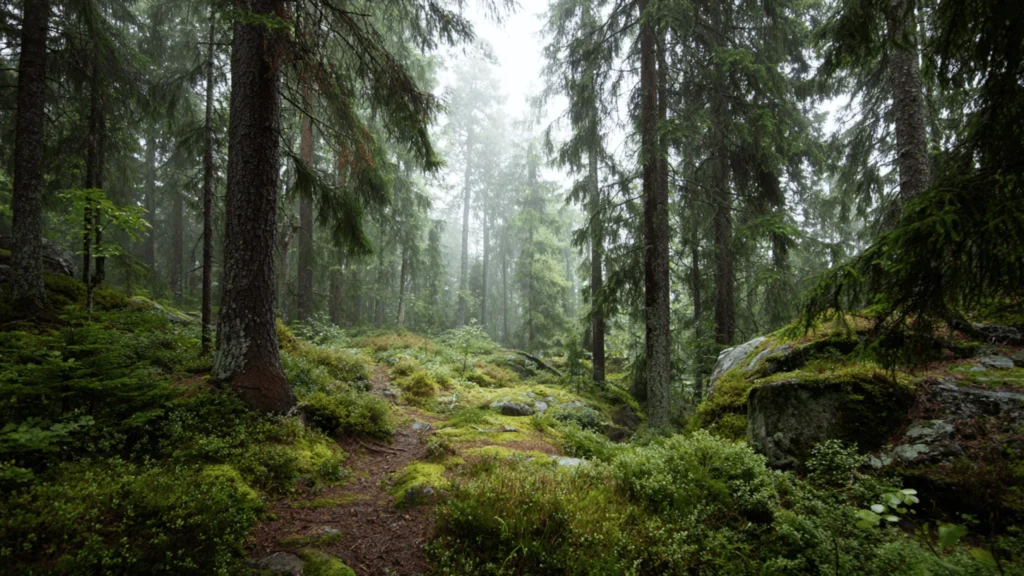
You see wood in this picture.
Many readers also wonder how “forest” differs from similar words.
- Forest usually suggests a larger, denser area.
- Woods often suggests a smaller, more open area.
- Jungle points to dense tropical growth.
- Rainforest is a specific kind of forest with very high rainfall.
None of these words takes a double r.
FAQs
Is “forrest” ever correct?
Yes, but only as a name. It works as a first name or surname. It is never correct for a wooded area.
Is it “Forest Gump” or “Forrest Gump”?
It is Forrest Gump, with two r’s. That is the character’s name.
How do you pronounce forest?
Both words sound the same: FOR-ist.
Is “forrest” a typo or a real word?
As a common word, it’s a misspelling. As a name, it’s real.
Do British and American English spell forest differently?
No. Both use forest. The spelling is the same worldwide.
Conclusion
Use forest for trees. Use Forrest for a person who spells their name that way, and always check the spelling.
When in doubt, ask one question: Am I describing land or naming someone? Land gets one r. A person’s name may get two.
Read More Blogs
- Is Condensation Endothermic or Exothermic?
- El Agua or La Agua: Which Is Correct in Spanish?
- Are Tulips Annuals or Perennials? How to Make Them Bloom Again
- Are Sunflowers Annuals or Perennials: Key Differences Explained
- Jewelry or Jewellery: Which Spelling Is Correct.
- Staring or Starring: The Simple Difference, With Examples