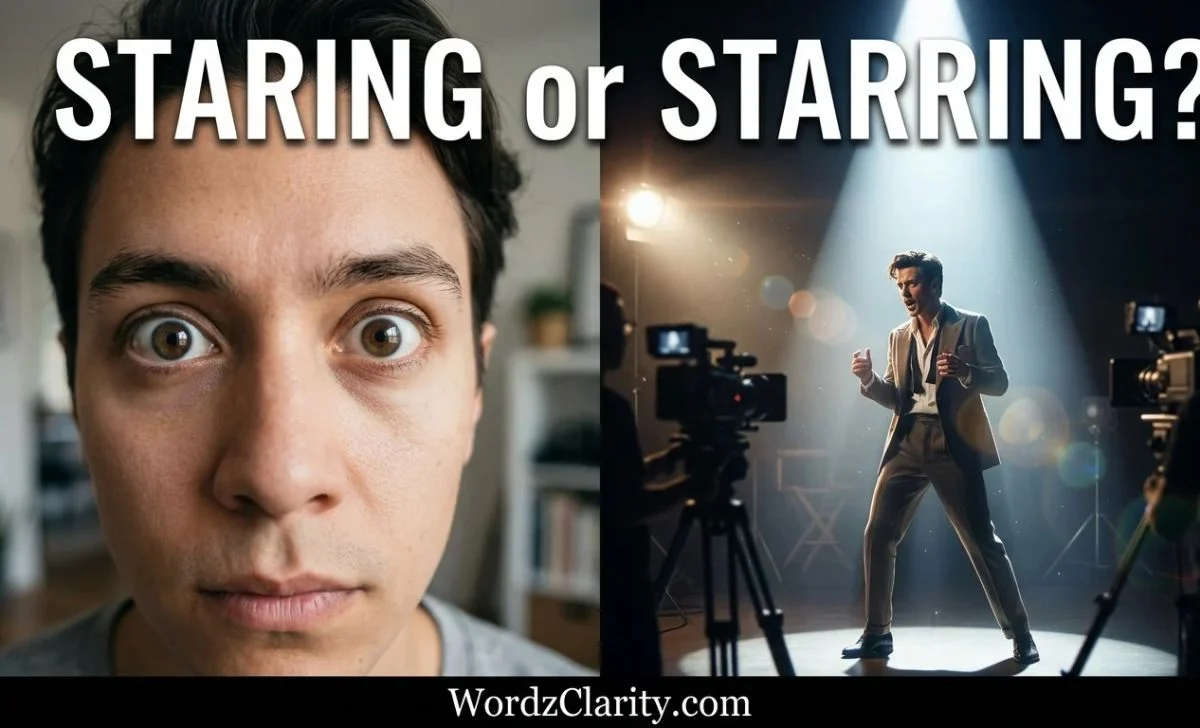
Staring means looking at something for a long time. Starring means playing a lead role.
The two words differ by one letter, but their meanings are far apart. Here is a quick comparison:
- The cat is staring at the bird.
- The film is starring a famous actor.
Mix them up, and the sentence turns odd. “The movie is staring Emma Stone” suggests the film itself is gazing at her.
Staring vs Starring at a Glance
| Staring | Starring | |
|---|---|---|
| Comes from the verb | Stare | Star |
| Meaning | Looking fixedly at something | Appearing in a lead role |
| What usually follows | “at,” “into,” or “out of” | “in,” or the performer’s name |
| Typical setting | Everyday life and description | Movies, plays, TV, sports |
| Example | He was staring at the screen. | A drama starring a British actor |
What Does “Staring” Mean?
Staring is the “-ing” form of the verb stare. Merriam-Webster defines stare as looking fixedly, often with wide-open eyes.
A stare lasts longer than a glance. It can show shock, boredom, deep thought, or rudeness.
Here are some examples:
- She sat staring out the window.
- The child kept staring at the cake.
- Why are you staring at me?
The dictionary notes that “stare” is often used with “at.” That small word is a useful clue. If “at” fits after the verb, you probably need staring.
A Word With Deep Roots
The verb is very old. Merriam-Webster traces it to Old English “starian,” and says its first known use came before the 12th century.
What Does “Starring” Mean?
Starring is the “-ing” form of the verb star. As a verb, star means to feature a performer in the most prominent or important role.
You will often see it on posters and in credits. Here are some examples:
- A comedy starring Ryan Reynolds
- She is starring in a new Broadway show.
- A concert starring some of the biggest names in music
Notice two patterns. People star in something. A production can also star someone directly, as in “a film starring Emma Stone.”
Starring Beyond the Screen
The word is not limited to movies. Merriam-Webster’s examples include an athlete who starred for a basketball team.
Another sense appears in reviews and guides. A restaurant can be “starred” in a guidebook, and a review can be a “starred review.” That sense uses “starred,” not “starring,” but it shows how far the verb stretches.
Why Do People Mix Them Up?
There are three common reasons.
The Spelling Is Almost the Same
The words differ by a single letter. That makes the slip easy to miss, especially when proofreading in a hurry.
Spell Checkers Accept Both
A missing “r” turns “starring” into “staring.” Both are real words, so most spell checkers will not flag the error.
The Spelling Rules Feel Odd
Many writers forget why one word drops a letter and the other doubles one. The next section explains it.
The Spelling Rule Behind the Confusion
This is where most guides stop short. Once you know the rule, you will remember the spelling.
Why “Stare” Becomes “Staring”
The verb stare ends in a silent “e.” When a word ends in a silent “e,” you drop the “e” before a suffix that starts with a vowel, such as “-ing.” So stare becomes staring.
The same rule explains page and paging.
Why “Star” Becomes “Starring”
The verb star has no silent “e.” It ends in a single consonant after a single vowel. The doubling rule says a final consonant doubles before a vowel suffix like “-ing” when a single vowel comes before it. So star becomes starring.
Compare it with mop and mopping.
The Quick Takeaway
- Silent “e” dropped, one “r” = staring
- Doubled “r” = starring
Easy Memory Tricks
Pick the one that works best for you.
The “Star” Trick
Look inside starring. You can see the word star. A star is a lead performer.
The “Stare” Trick
Look inside staring. You can see stare. Stare is what your eyes do.
The Follow-Up Word Trick
- If “at,” “into,” or “out of” fits next, write staring. (staring at, staring into space)
- If “in” or a performer’s name fits next, write starring. (starring in, starring Emma Stone)
Related Forms You Should Know
You will meet other forms of these verbs too.
Stare: Stared, Stares, Staring
Merriam-Webster lists the forms as stare, stared, and staring.
- She stared at the sky.
- He stares at his phone too often.
Star: Starred, Stars, Starring
The dictionary lists the forms as starred, starring, and stars.
- She starred in three films.
- The series stars a famous actress.
- A co-star shares the spotlight with the lead.
Both “starring” and “starred” are correct. You choose the one that fits the tense.
Staring Phrases You May Hear
The verb appears in some familiar expressions.
- Staring into space: looking at nothing while lost in thought
- Staring contest: a game where players try not to blink
- Staring you in the face: very obvious, yet overlooked
Merriam-Webster also lists “stare one in the face” as a related expression.
Common Mistakes
Here are typical errors, each with the correct version.
| Wrong | Right |
|---|---|
| The film is staring Tom Hanks. | The film is starring Tom Hanks. |
| He was starring at the wall. | He was staring at the wall. |
| She is staring in a new play. | She is starring in a new play. |
| They kept starring at the sky. | They kept staring at the sky. |
These errors show up in captions, headlines, and social posts. One wrong letter changes the meaning completely.
Real-Life Examples
Imagine you run a small cinema blog. You write a caption: “Tonight’s thriller staring Emma Stone.” Readers may smile, but your page looks careless.
Now imagine a school report that says: “The student kept starring out of the window.” A parent might wonder if the student was in a play.
[Add a short example from your own writing or editing experience here. A real story builds trust.]
Small slips like these cost you credibility. A quick proofread takes seconds.
Synonyms to Vary Your Writing
You do not always need the same word. Try these.
Instead of Staring
- Gazing
- Glaring (an angry stare)
- Peering
- Watching closely
Instead of Starring
- Featuring
- Headlining
- Playing the lead
- Taking the leading role
Quick Practice: Choose the Right Word
Try these. The answers follow.
- The cat kept ______ at the empty bowl. (staring/starring)
- The new drama is ______ a famous British actor. (staring/starring)
- He spent the whole lesson ______ into space. (staring/starring)
- She is ______ in her first leading role. (staring/starring)
Answers: 1) staring. 2) starring. 3) staring. 4) starring.
FAQs
What is the difference between staring and starring?
Staring means looking fixedly at something. Starring means playing a lead role in a film, play, or show.
Is it “staring in a movie” or “starring in a movie”?
It is “starring in a movie.” “Staring in” is a spelling mistake.
How do I spell the “-ing” form of stare?
Drop the silent “e” and add “-ing.” That gives “staring.”
Why does “starring” have two r’s?
The verb “star” ends in a single consonant after a single vowel. That pattern calls for doubling the final letter before “-ing.”
Is “starred” correct too?
Yes. “Starred” is the past form. “Starring” is the “-ing” form.
Can someone be “starring at” something?
No. Use “staring at” for looking. Keep “starring” for performers and featured roles.
Conclusion
The staring or starring question is simple once you see the pattern. Staring is about the eyes. Starring is about the spotlight.
Check the word that follows. If “at” fits, write staring. If “in” or a performer’s name fits, write starring. Then confirm the spelling rule: staring drops the silent “e,” and starring doubles the “r.”
Use these checks, and you will pick the right word every time.
Read More Blogs
- Steel or Steal: What Is the Difference?
- Prey vs. Pray: Complete Guide to Meaning, Spelling & Usage
- Herd or Heard: What’s the Difference?
- Coarse or Course: How to Choose the Right Word Every Time