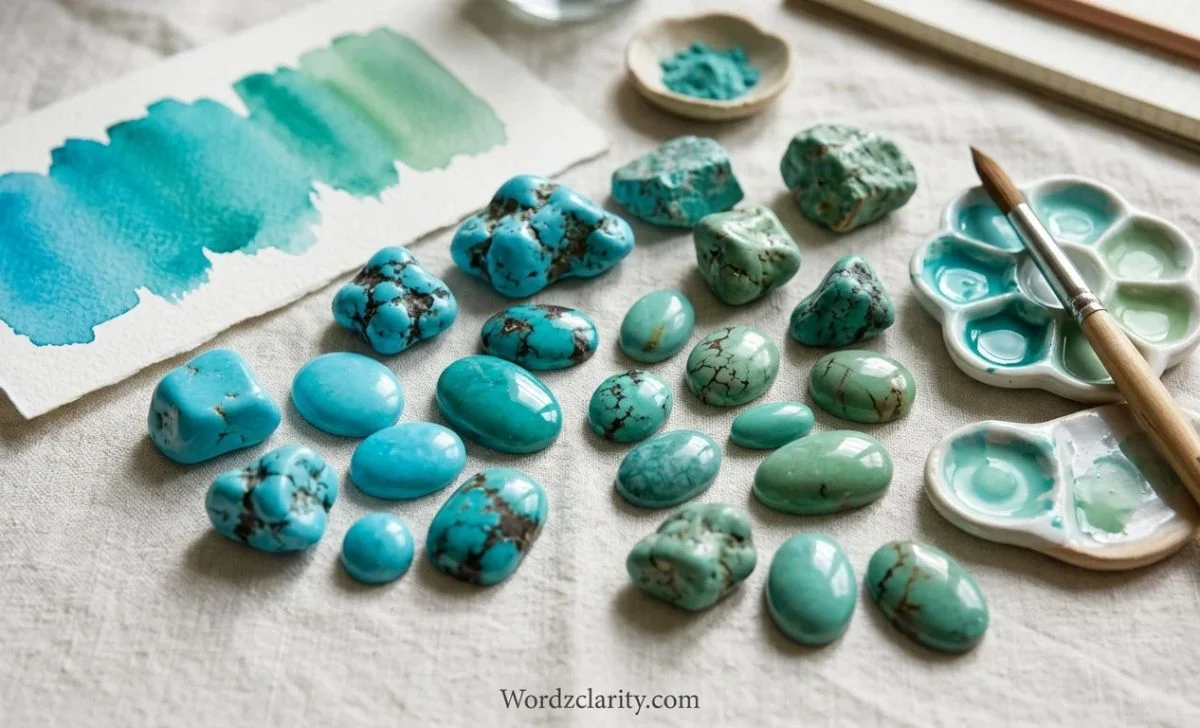
You hold up a turquoise scarf. One friend says it’s blue. Another swears it’s green.
Both people are looking at the same fabric. And both have a point.
Short answer: turquoise is both. It sits on the line between blue and green. Some shades lean blue. Others lean green.
This guide explains why, how to tell which way a shade leans, and where the confusion comes from.
Is Turquoise Blue or Green? The Quick Answer
Turquoise is a blue-green color. Dictionaries describe it as a greenish blue or a bluish green.
That means the honest answer depends on the exact shade and on the person looking.
- Light, sky-like turquoise: reads as blue.
- Minty, tropical turquoise: reads as green.
- Middle turquoise: reads as both, and people argue.
Why Turquoise Sits Between Blue and Green
On a color wheel, blue and green are neighbors. Halfway between them sits cyan. Turquoise lives right around that point.
Quillbot’s color guide notes that if a turquoise shade is very close to cyan, some people call it blue while others call it green. That explains most of the debate.
The Standard Web Color
Web designers use a named color called “turquoise.” Its hex code is #40E0D0.
That shade sits at a hue of about 174°. Cyan sits at 180°. So the official web turquoise leans slightly toward green.
A Simple Test for Any Shade
Want to know which way your turquoise leans? Use hue.
- Find the hue angle of your color in any editor.
- Compare it to 180°, the cyan midpoint.
- Below 180° means it leans green. Above 180° means it leans blue.
No editor handy? Hold the color next to a true cyan swatch. Your eyes will pick up the lean fast.
Turquoise the Gemstone: Why It Comes in Blue and Green
The color name comes from the gemstone. So the stone is the best place to look for answers.
Turquoise is a mineral made of copper, aluminum, and phosphate. Two metals decide its color.
Copper Makes It Blue
Copper gives turquoise its blue tone. More copper means a deeper, richer blue.
The prized Persian turquoise from Iran is known for an intense blue with almost no green tint.
Iron Makes It Green
When iron is present, the stone shifts toward green. That is why one mine can produce both blue and green stones.
Some sources also say blue stones can turn greener with heat, weathering, or loss of natural moisture over time. Jewelers often warn that heat, oils, and chemicals can change a stone.
Which Color Is More Valuable?
The Gemological Institute of America says the most prized turquoise is an even, intense, medium blue. Trade names include “robin’s egg blue” and “sky blue.”
Greener stones usually sell for less. But the GIA adds that taste matters. Some modern designers actively seek avocado and lime-green turquoise.
Turquoise vs Aqua vs Teal vs Cyan
These four colors blur together. Here is how to separate them.
| Color | Typical look | Common hex |
|---|---|---|
| Cyan | The exact midpoint of blue and green | #00FFFF |
| Aqua | Light, watery blue-green | #00FFFF (same as cyan on the web) |
| Turquoise | Greenish blue, bright and soft | #40E0D0 |
| Teal | Darker, deeper blue-green | #008080 |
In plain words: teal is darker, aqua is bluer, and turquoise is the bright, balanced one in between. Many people say turquoise leans a touch greener than aqua.
Why People Disagree About Turquoise
Two things cause the fight: how eyes work and how languages work.
Eyes and Brains Differ
Remember the 2015 internet debate over “the dress”? Some people saw blue and black. Others saw white and gold. Same photo. Different brains.
Border colors like turquoise trigger the same kind of split. Lighting, screens, and personal habits all play a part.
Languages Draw the Line in Different Places
Many languages group blue and green differently than English does. Japanese is a famous example. The word ao has long covered both blue and green. That is why many Japanese speakers still call a green traffic light “blue.”
English makes you pick a side. But turquoise sits right where the line is blurry.
Turquoise Blue vs Turquoise Green Shades
Since the name covers a range, designers add a second word. This keeps things clear.
| Shade name | Hex code | Leans toward |
|---|---|---|
| Pale Turquoise | #AFEEEE | Blue-green, very light |
| Turquoise | #40E0D0 | Slightly green |
| Medium Turquoise | #48D1CC | Balanced |
| Dark Turquoise | #00CED1 | Slightly blue |
| Turquoise blue (Quillbot example) | #40D0E0 | Blue |
| Turquoise green (minty example) | #A0D6B4 | Green |
Use these as starting points. Always test colors on your own screen.
How to Make Turquoise
You can mix it with paint. Combine blue and green.
- More blue: you get a sky-like turquoise.
- More green: you get a minty, tropical turquoise.
- A touch of white: you get a soft, pastel version.
Green is itself a mix of blue and yellow. So small changes in your starting blue or green can shift the final shade. Mix in small amounts and test on paper.
Where You See Turquoise in Real Life
Turquoise shows up everywhere, and the shades vary a lot.
- Tropical water: Caribbean shallows often glow turquoise.
- Jewelry: Southwestern and Persian jewelry features the stone in blue, green, and veined varieties.
- Branding: Tiffany & Co. built a famous identity on its robin’s-egg blue box color.
- Design trends: Pantone named Turquoise its Color of the Year for 2010.
The Tiffany box shows how powerful a single shade can be. Most people call it blue. A few call it green. Everyone recognizes it.
What Does the Color Turquoise Mean?
Turquoise blends the calm of blue with the freshness of green.
Designers often link it with:
- Calm and clarity
- Healing and balance
- Communication and openness
- Creativity and fun
In many cultures, sky-blue turquoise stones are also considered lucky.
Colors That Go With Turquoise
Try these palettes:
- Clean and modern: turquoise green, navy, white, and slate gray.
- Fresh and natural: turquoise blue, sage green, ivory, and forest green.
- Bold and warm: turquoise with coral or sunny yellow.
Navy and white keep turquoise looking crisp. Warm colors make it pop.
How to Describe Your Turquoise Clearly
If you are writing a product page, a paint order, or a design brief, vague words cause returns and rework.
Be specific:
- Add a direction: “turquoise blue” or “turquoise green.”
- Add a hex code, such as #40E0D0.
- Add a comparison, like “similar to a robin’s egg.”
- Show a photo in natural light.
This simple habit saves a lot of confusion.
FAQs
Is turquoise more blue or more green?
It depends on the shade. The standard web turquoise leans slightly green. Gemstone turquoise ranges from sky blue to green.
Is turquoise a shade of blue?
Often, yes. Many dictionaries call it a greenish blue. But it is also correct to call it a bluish green.
What two colors make turquoise?
Blue and green. Add a little white for a lighter, pastel turquoise.
Is teal the same as turquoise?
No. Teal is darker and deeper. Turquoise is brighter and lighter.
Is aqua the same as turquoise?
They are close, but not identical. Aqua is lighter and more watery. Turquoise has a bit more green richness.
Why is some turquoise stone green?
Iron in the mineral pushes it toward green. Copper pushes it toward blue.
What is the most valuable turquoise color?
An even, medium blue is usually the most prized.
What is the hex code for turquoise?
The standard web color is #40E0D0.
Final Thoughts
So, is turquoise blue or green? It is both, and that is the point.
Turquoise lives on the border. Its exact lean depends on the shade, the light, and the eye. Use a hex code or a word like “turquoise blue” when precision matters.
Next time someone argues, smile. You can both be right.
Read More Blogs
- Prey vs. Pray: Complete Guide to Meaning, Spelling & Usage
- Coarse or Course: How to Choose the Right Word Every Time
- Onto or Into: Understanding the Difference With Examples