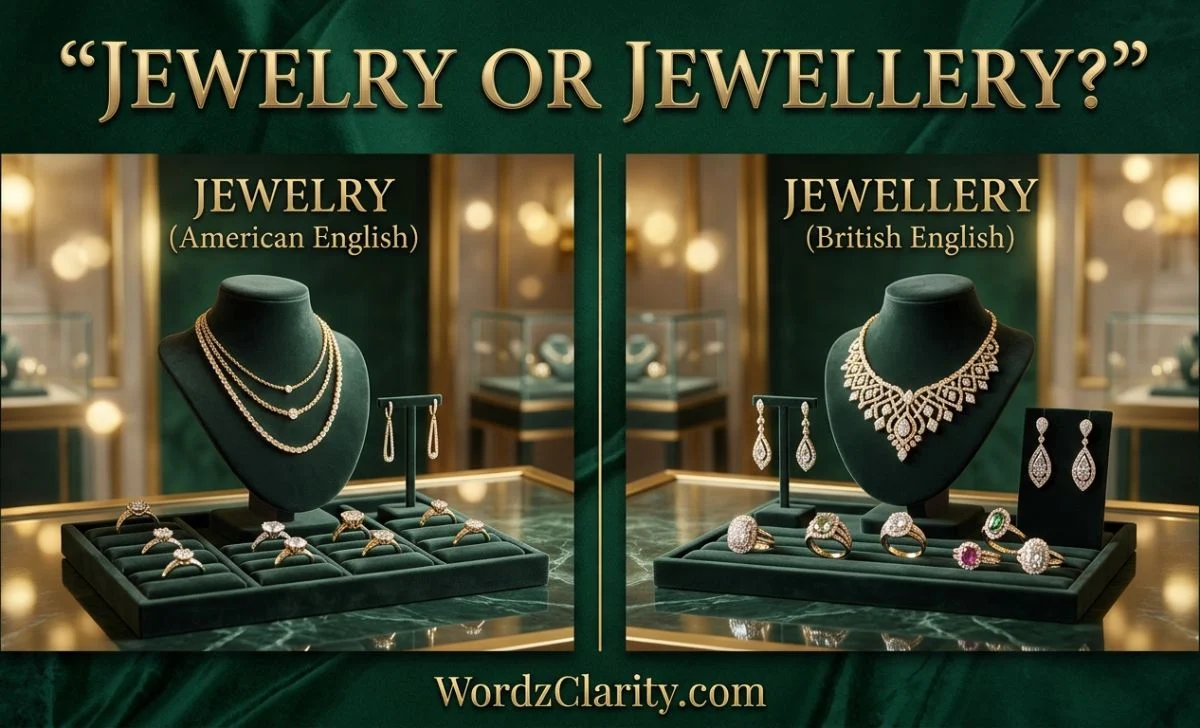
Both spellings are correct. They are the same word.
Use jewelry in American English. Use jewellery in British English. The meaning stays the same.
Merriam-Webster treats jewelry as the US spelling and jewellery as the chiefly British variant. Your readers decide which one fits.
Jewelry vs Jewellery at a Glance
| Jewelry | Jewellery | |
|---|---|---|
| Used in | United States | Britain, Australia, and most English outside North America |
| Spelling | One “l” | Two “l”s and an extra “e” |
| Maker or seller | Jeweler | Jeweller |
| Decorated with gems | Jeweled | Jewelled |
Jewelry is preferred in American English, while jewellery is preferred in varieties of English from outside North America.
What Does Jewelry Mean?
Jewelry is a noun. It names objects worn to decorate the body. Necklaces, bracelets, and rings all count.
The word does not require gemstones. A wooden pendant or a plain gold ring is still jewelry.
It also works as a collective noun. So say “a piece of jewelry,” not “a jewelry.”
When to Use “Jewelry”
Choose jewelry when you write for American readers. That includes websites, product pages, emails, and school or business documents.
Here are two examples:
- She keeps her grandmother’s jewelry in a small wooden box.
- The shop sells handmade silver jewelry.
When to Use “Jewellery”
Choose jewellery when you write for readers in the UK, Australia, and similar regions. It is the correct spelling in both Britain and Australia.
Here are two more examples:
- The jewellery shop on the high street opens at nine.
- He designs modern jewellery for a London brand.
What About Canadian English?
Canada is the tricky case. Sources disagree here.
One source says Canadian English uses both spellings, with jewellery generally more popular. Grammarist says both appear there, but jewelry leads by about two to one.
So what should you do? Pick one spelling and stay consistent. If you work with a style guide, follow it.
Why Are There Two Spellings?
The split follows the wider gap between American and British spelling.
Noah Webster, the 19th-century lexicographer, helped make the shorter American form standard, although he did not invent it.
The same pattern appears in many other words. Americans write “color” and “theater.” The British write “colour” and “theatre.”
The word itself is old. It comes from Old French and goes back to the 14th century in English.
Related Words That Change Too
The spelling split reaches the whole word family.
| American | British |
|---|---|
| Jeweler | Jeweller |
| Jeweled | Jewelled |
| Jeweling | Jewelling |
The base word “jewel” is spelled the same in every variety of English. Never write “jewell.”
Do the Two Spellings Sound Different?
No. The spelling changes, but the pronunciation does not.
Grammarphobia explains that the word should sound the same on both sides of the Atlantic. It adds that Fowler’s usage guide gives “JOO-ul-ree” as the correct form.
Merriam-Webster agrees on the standard sound. It marks the form “JOO-luh-ree,” with an extra vowel, as nonstandard.
Many people add that extra sound anyway. It is a common habit, so don’t worry if you hear it.
A Simple Trick to Remember the Difference
Here is a memory aid that works well. The extra “l” and “e” in “jewellery” match the first letters of London, England.
If you see the longer spelling, think of London. For the shorter one, think of the USA.
Common Mistakes to Avoid
Small slips make writing look careless. Watch for these.
Mixing Both Spellings
Do not write “jewelry” in one paragraph and “jewellery” in the next. Choose one version and use it for the whole piece.
Mismatching Related Words
“Jewellery” beside “jeweler” looks inconsistent. Match the whole family: jewellery with jeweller, or jewelry with jeweler.
Spelling It “Jewelery”
This is a common misspelling. Merriam-Webster lists only jewelry and jewellery as the standard forms. When unsure, check a dictionary.
Ignoring Your Audience
Your reader’s location matters more than your own habit. A UK shop that writes “jewelry” can look out of place to local buyers.
Does the Spelling Matter for SEO?
It can. People search with the spelling they use every day.
Imagine you run an online store that ships to the UK. A shopper there types “gold jewellery.” If your pages only say “jewelry,” you may miss some of that traffic.
An industry article makes a similar point about the related word jeweler. It advises American-market businesses to use “jeweler” to match what American customers search for.
A few practical steps help:
- Match the spelling to your main market.
- Use one spelling across titles, headings, and body text.
- If you serve both markets, consider separate pages for each.
Quick Practice: Choose the Right Spelling
Try these. The answers follow.
- A shop on a London high street sells antique ______. (jewelry/jewellery)
- My New York ______ repaired the clasp. (jeweler/jeweller)
- A British magazine praised the ______ crown on display. (jeweled/jewelled)
Answers: 1) jewellery. 2) jeweler. 3) jewelled.
FAQs
Is it jewelry or jewellery?
Both are correct. Use jewelry for American readers and jewellery for British, Australian, and similar audiences.
Which spelling is more common?
It depends on the region. Jewelry leads in the United States, and jewellery leads in Britain.
Is “jewelery” correct?
No. It is a common misspelling. Use “jewelry” or “jewellery.”
Do the two spellings mean the same thing?
Yes. They name the same decorative items.
How do I spell the person who makes jewelry?
Use “jeweler” in American English and “jeweller” in British English.
Does the pronunciation change?
No. The sound stays the same in both types of English.
Conclusion
The jewelry or jewellery question has a simple answer. Both are right, and your audience decides.
Write jewelry for the United States. Write jewellery for the UK, Australia, and most places outside North America. Stay consistent, and match related words like jeweler and jeweller.
Get that right, and your writing will look polished every time.
Read More Blogs
- Each vs Every: When to Use Each and Every Correctly
- Premier vs Premiere: Learn the Difference With Easy Examples
- Repast or Repass: Meaning, Difference, Pronunciation, and Usage
- Canvas vs Canvass: Meaning, Difference, and Examples
- Censored vs. Sensored: How to Tell These Words Apart