Some English words are confusing because they look alike. Others cause problems because they sound similar. Rather and whether fall into a different category.
They don’t share the same meaning, spelling, or grammar, yet many English learners still mix them up because both often appear in sentences involving decisions or choices.
As a result, it’s common to see mistakes like “I’d whether stay home” or uncertainty about which word fits a particular sentence. The good news is that the difference is much simpler than it first appears.
Once you understand the role each word plays, choosing the correct one becomes almost automatic. In this guide, you’ll learn when to use rather and whether, how native English speakers naturally use them, the grammar rules behind each word, and the mistakes you should avoid.
By the end, you’ll be able to use both words confidently in conversations, emails, academic writing, and professional communication.
Quick Answer: Rather vs Whether
If you’re looking for the short answer, here it is:
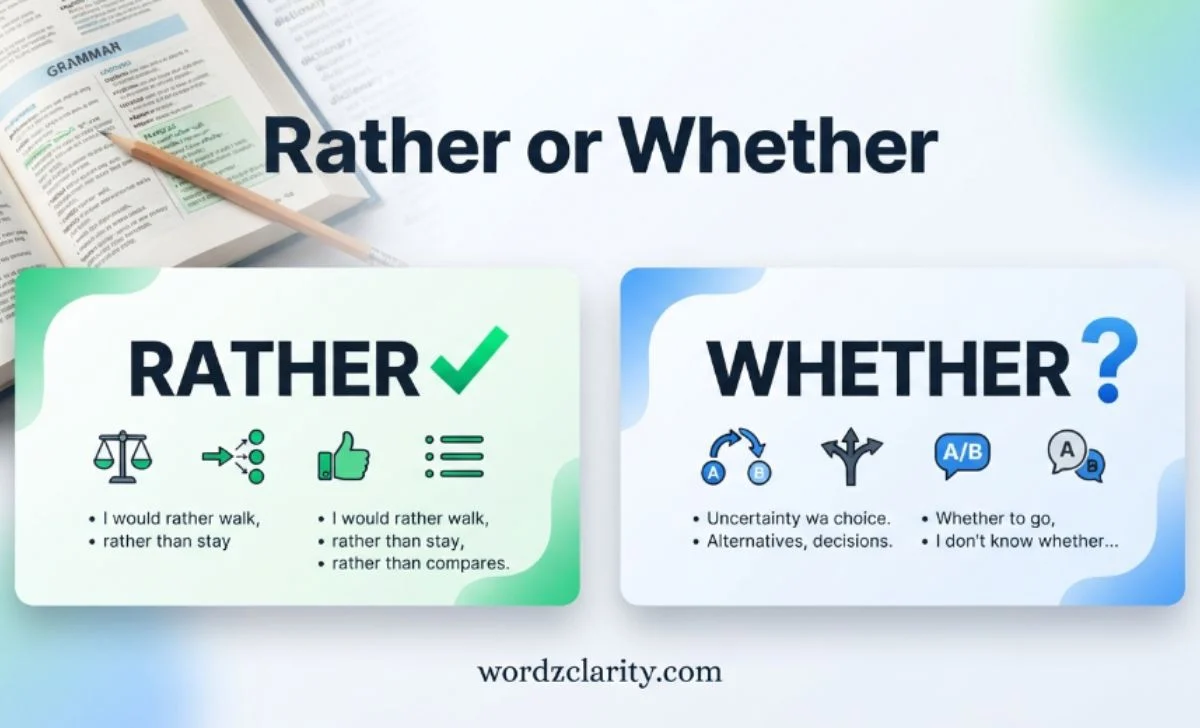
- Use rather to express a preference, comparison, or degree.
- Use whether to introduce alternatives, choices, or uncertainty.
Although these words are often searched together, they cannot replace each other because they perform different grammatical functions.
| Rather | Whether |
|---|---|
| Shows preference or comparison | Introduces alternatives or uncertainty |
| Functions mainly as an adverb | Functions as a subordinating conjunction |
| Common in would rather, rather than, and or rather | Common in whether or not, whether…or, and whether to |
Examples
✔ I’d rather finish the report before lunch.
✔ She’d rather study at the library than at home.
✔ We haven’t decided whether to attend the conference.
✔ Let me know whether you can join the meeting tomorrow.
A simple way to remember the difference is:
Rather = Preference
Whether = Possibility or Choice
If your sentence is about what someone prefers, rather is usually the correct word. If it’s about two possible outcomes or an uncertain situation, whether is the right choice.
Why Are “Rather” and “Whether” Often Confused?
At first glance, these two words don’t seem related. So why do so many people search for rather or whether?
The answer lies in the situations where they’re used. Both words often appear when someone is making a decision, but they describe different parts of that decision.
Think about these questions:
Which option do I prefer?
I’d rather work from home today.
Now compare it with:
Which option is true?
I don’t know whether the office is open today.
The first sentence expresses a personal preference. The second introduces uncertainty because the speaker doesn’t know the answer yet.
Many English learners focus only on vocabulary, but English grammar depends heavily on the job a word performs inside a sentence. Once you understand that rather expresses preference while whether introduces alternatives, the confusion usually disappears.
How “Rather” Changes the Meaning of a Sentence
The word rather is far more flexible than many learners realize. While it’s best known for expressing preference, it can also make descriptions more balanced, compare alternatives, or even correct a previous statement.
Instead of memorizing several grammar rules, it’s easier to understand rather through the situations where native speakers naturally use it.
Expressing Preference
This is the use you’ll encounter most often in everyday English.
Examples:
- I’d rather work from home on Fridays.
- We’d rather leave early than sit in heavy traffic.
- She’d rather save for a holiday than buy another phone.
- My parents would rather spend time outdoors than watch television all weekend.
In each example, the speaker is choosing one option over another.
One important grammar rule is worth remembering:
After would rather, always use the base form of the verb.
✔ I’d rather stay.
✔ We’d rather leave.
✘ I’d rather to stay.
✘ We’d rather leaving.
These mistakes are common because learners confuse would rather with other English verb patterns. Fortunately, the rule is simple: would rather + base verb.
Comparing Two Alternatives
Another common expression is rather than, which compares two options while showing which one is preferred.
For example:
- The company invested in employee training rather than hiring more temporary staff.
- We decided to travel by train rather than drive for six hours.
- She chose practical experience rather than another certificate.
This structure is common in business communication, academic writing, and professional reports because it creates clear and logical comparisons.
Adding Moderate Emphasis
Native speakers also use rather to soften or strengthen an opinion without sounding too dramatic.
Consider these sentences:
- The presentation was rather impressive.
- This solution is rather practical.
- The weather has become rather cold this week.
Here, rather means something close to fairly or quite. It adds emphasis without making the statement sound exaggerated.
This usage appears frequently in British English and is also understood in American English, especially in formal writing.
Correcting What You Just Said
Sometimes speakers realise they haven’t expressed themselves accurately. Instead of starting over, they use or rather to make a quick correction.
For example:
- He works in Manchester or rather, just outside Manchester.
- The meeting starts at ten or rather, ten thirty.
- She’s my cousin or rather, my second cousin.
Using or rather makes speech sound natural because it allows the speaker to clarify information without interrupting the conversation.
When Should You Choose “Rather”?
A quick question can help you decide.
Are you expressing what someone prefers, comparing two options, or making a statement more precise?
If the answer is yes, rather is almost certainly the correct choice.
For example:
At work
I’d rather send the proposal today than rush it tomorrow.
The speaker chooses one course of action over another.
At university
Most students would rather attend practical workshops than listen to another long lecture.
The sentence compares two learning preferences.
While travelling
We’d rather book our tickets early because prices usually increase closer to the departure date.
The speaker explains the preferred decision based on experience.
In everyday conversation
I’d rather cook dinner at home than order takeaway again.
This sounds natural because native speakers regularly use would rather when talking about everyday preferences.
Common Mistakes Learners Make with “Rather”
Knowing the meaning of rather is only half the job. Many English learners understand what the word means but still use it incorrectly because they follow the wrong grammar pattern. Learning these mistakes now will help you avoid them in your own writing.
| Incorrect | Correct | Why It’s Wrong |
|---|---|---|
| I’d rather to leave now. | I’d rather leave now. | Would rather is followed by the base form of the verb. |
| We’d rather going by train. | We’d rather go by train. | Don’t use the -ing form after would rather. |
| She’d rather stays home. | She’d rather stay home. | The verb should remain in its base form. |
| I’d whether stay home. | I’d rather stay home. | Whether cannot express preference. |
Instead of memorizing these examples, remember one simple rule:
If the sentence answers “What do you prefer?”, use rather.
That single question will help you choose the correct word in most situations.
Native Speakers Use “Rather” More Naturally Than You Think
Many learners believe rather is an old-fashioned or overly formal word. In reality, native speakers use it every day, although the way they use it depends on the situation.
In casual conversations, you’ll often hear would rather when someone is talking about personal choices.
- “I’d rather watch a movie tonight.”
- “We’d rather order pizza than cook.”
- “She’d rather call you tomorrow.”
In workplaces, rather helps people sound polite without being indirect.
Instead of saying:
“I don’t want another meeting.”
A manager might say:
“I’d rather discuss this over email.”
The second version sounds more professional while still expressing a clear preference.
In academic writing, rather than is frequently used to compare ideas.
For example:
“The research focuses on long-term solutions rather than short-term fixes.”
This structure creates smoother, more logical comparisons, which is one reason it appears so often in reports, essays, and professional documents.
A Simple Trick to Remember “Rather”
If grammar rules are difficult to remember, use this shortcut instead.
Imagine someone asks:
“Which option do you prefer?”
If your answer begins with a preference, rather is probably the correct word.
For example:
Question: Tea or coffee?
Answer: I’d rather drink coffee.
Now imagine a different question.
“Which possibility is true?”
That question doesn’t ask for a preference. It asks for information or certainty. In those situations, whether is usually the correct word.
Thinking about the question behind the sentence is much easier than trying to memorize dozens of grammar rules.
Understanding “Whether” and When to Use It
Unlike rather, which expresses a preference, whether is used when the answer is unknown or when two or more possibilities exist. It doesn’t tell readers what someone wants , it tells them that a decision, doubt, or alternative is involved.
For that reason, whether is classified as a subordinating conjunction. Its job is to connect a main clause with another clause that presents uncertainty or different possibilities.
Consider these examples:
- We haven’t decided whether to move next year.
- I don’t know whether she’s accepted the job.
- Please let me know whether you’ll attend the meeting.
In each sentence, the speaker isn’t expressing a preference. Instead, they’re introducing something that hasn’t been decided or confirmed.
When Is “Whether” the Right Choice?
A simple question can help you choose the correct word.
Does your sentence involve uncertainty, two alternatives, or a decision that hasn’t been made yet?
If the answer is yes, use whether.
Talking About Uncertainty
This is the most common use.
Examples:
- Nobody knows whether the weather will improve tomorrow.
- Scientists are studying whether the new treatment is effective.
- We haven’t confirmed whether the flight has been delayed.
Each sentence introduces information that is still unknown.
Presenting Two Alternatives
Sometimes whether appears with or to show two possible outcomes.
Examples:
- She couldn’t decide whether to study abroad or stay in her hometown.
- We’ll continue whether it rains or not.
- The manager is considering whether to hire another employee or expand the current team.
Here, whether connects two alternatives without suggesting that one is preferred over the other.
Using “Whether or Not”
The expression whether or not emphasizes that something will happen regardless of the outcome.
Examples:
- We’ll support the project whether or not it receives additional funding.
- The event will take place whether or not it rains.
- You should apply whether or not you meet every preferred qualification.
This phrase is common in formal writing because it makes the meaning clear and complete.
Rather vs Whether: Side-by-Side Comparison
Although these words are often searched together, they belong to different parts of English grammar.
| Feature | Rather | Whether |
|---|---|---|
| Part of speech | Adverb | Subordinating conjunction |
| Main purpose | Shows preference or comparison | Introduces uncertainty or alternatives |
| Common expressions | Would rather, rather than, or rather | Whether to, whether or not, whether…or |
| Typical question answered | Which option do you prefer? | Which possibility is true? |
Compare these sentences
✔ I’d rather work remotely.
✔ We haven’t decided whether we’ll work remotely.
The first sentence expresses a preference.
The second introduces uncertainty.
That single difference explains almost every situation where these two words are confused.
Whether vs If: A Common Grammar Question
Many learners also wonder whether whether and if mean the same thing.
In everyday conversation, they’re sometimes interchangeable.
For example:
- I don’t know if he’s coming.
- I don’t know whether he’s coming.
Both are acceptable in informal English.
However, whether is the better choice in several situations.
Use whether when:
- presenting two alternatives
- writing formally
- using whether or not
- writing after certain verbs and prepositions where if sounds less natural
For example:
✔ Please confirm whether you can attend.
✔ The discussion focused on whether the policy should change.
Using whether in these situations makes your writing sound clearer and more professional.
Common Mistakes to Avoid
Even advanced English learners sometimes confuse these words because they associate both with making decisions.
Here are some mistakes worth remembering.
❌ I’d whether stay home.
✔ I’d rather stay home.
❌ She’d rather to leave early.
✔ She’d rather leave early.
❌ Tell me rather you’re available.
✔ Tell me whether you’re available.
❌ We discussed rather to continue.
✔ We discussed whether to continue.
A useful habit is to identify the purpose of your sentence before choosing the word.
- If it’s about preference, choose rather.
- If it’s about possibility or uncertainty, choose whether.
FAQs
1. Is it “rather” or “whether”?
It depends on your sentence. Use rather to express a preference and whether when introducing uncertainty or alternatives.
2. Can “rather” replace “whether”?
No. These words have different grammatical functions and cannot replace one another.
3. What does “would rather” mean?
Would rather means would prefer. It is used when someone chooses one option over another.
4. Is “whether” more formal than “if”?
In many situations, yes. While if is common in everyday conversation, whether is generally preferred in formal and academic writing, especially when presenting alternatives.
5. What is the easiest way to remember the difference?
Remember this simple rule:
- Rather = Preference
- Whether = Choice or Uncertainty
Conclusion
Although rather and whether are frequently searched together, they serve completely different purposes in English.
Rather helps you express a preference, compare alternatives, or soften a statement, while whether introduces uncertainty, alternatives, or decisions that haven’t yet been made.
Instead of memorizing long grammar rules, focus on the purpose of your sentence. If you’re talking about what someone prefers, rather is almost always the correct choice.
If you’re introducing two possibilities or an unknown outcome, whether is the word you need.
Once you understand this distinction, using these words becomes much more natural. With regular practice and exposure to real-life English, you’ll find yourself choosing the correct word automatically, whether you’re writing an email, preparing an assignment, or having an everyday conversation.
Read More Blogs:
Nineth or Ninth? Complete English Grammar Guide with Examples
Swam or Swum: Which Is Correct? Grammar Rules, Meaning