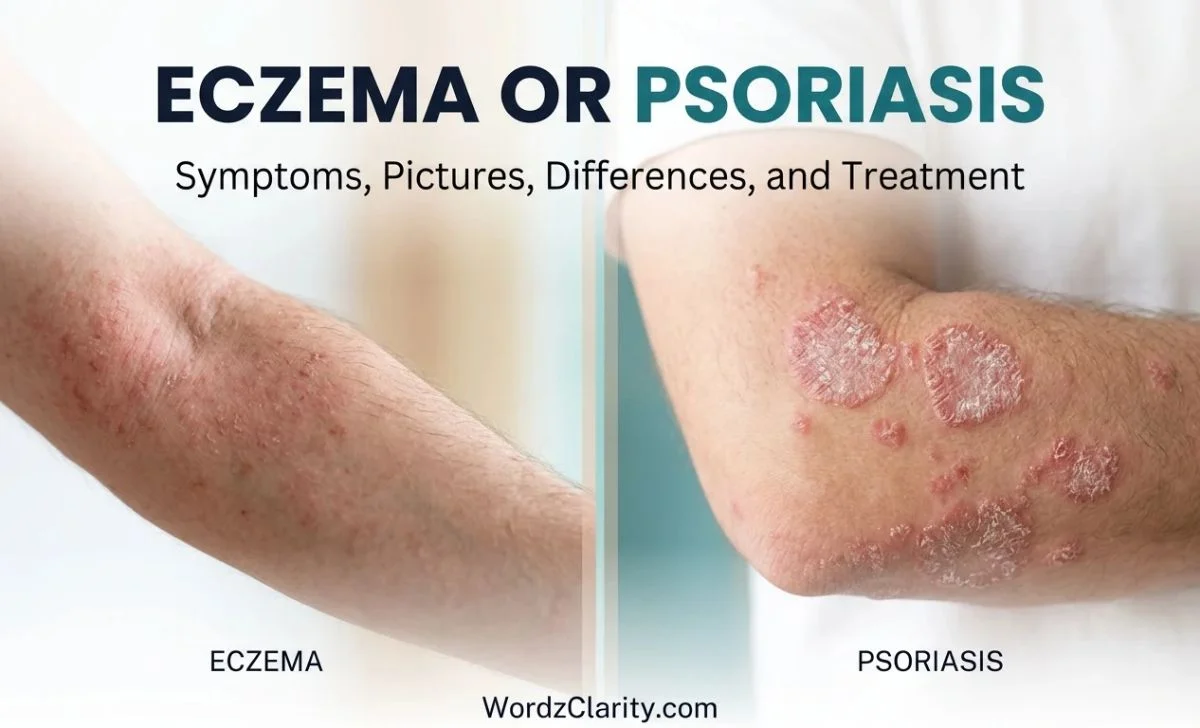
Skin rashes can be confusing. A patch of red, dry, or itchy skin may look like eczema, psoriasis, or another skin condition.
The two can share many symptoms, but they do not have the same causes or treatment needs. Knowing the differences can help you understand what you see and when to seek medical advice.
Eczema often causes intense itching, dry skin, and irritation. Psoriasis commonly produces thicker, raised patches with visible scales. However, these patterns are not always clear.
Skin tone, the affected body area, and the type of condition can all change how a rash looks. Some people may even have both conditions.
If you are comparing eczema or psoriasis, you may want to know which one itches more, how each looks in pictures, whether one is worse than the other, and which creams may help.
This guide explains the main differences in simple terms. You will also learn about common triggers, treatment options, diagnosis, and signs that mean it is time to see a dermatologist.
Quick Answer: Eczema or Psoriasis?
Eczema and psoriasis are both long-term inflammatory skin conditions, but they affect the skin in different ways.
- Eczema: Often causes very itchy, dry, irritated skin. Some types may develop small blisters, fluid, or crusting.
- Psoriasis: Often causes thick, raised patches with clear edges and dry scales. It commonly affects the elbows, knees, scalp, and nails.
- Main difference: Eczema is often linked to a weakened skin barrier and inflammation. Psoriasis involves an immune response that speeds up the growth of skin cells.
- Treatment: Both may need moisturizers and prescription treatments, but the right approach depends on the diagnosis and severity.
For example, itchy skin behind the knees may fit a common pattern of eczema. Thick, scaly patches on the elbows may suggest psoriasis. These examples are clues, not a diagnosis. A dermatologist can help tell them apart.
Eczema vs Psoriasis: Key Differences at a Glance
Eczema and psoriasis can both cause dry, itchy, inflamed skin. The main differences are often the appearance of the patches, the level of itching, and where the rash appears.
| Feature | Eczema | Psoriasis |
|---|---|---|
| Main cause | Skin barrier problems and inflammation; causes vary by eczema type | Immune-driven inflammation and faster skin cell turnover |
| Appearance | Dry, irritated patches with possible bumps or crusting | Often thick, raised patches with visible scales |
| Patch borders | May be less clearly defined | Often have sharp, clear edges |
| Itching | Often intense | Can itch, burn, or feel sore |
| Common locations | Skin folds, hands, face, and neck | Elbows, knees, scalp, and nails |
| Skin texture | Dry, rough, cracked, or thickened after scratching | Thick, scaly, raised, or cracked |
| Common triggers | Irritants, fragrances, weather, heat, and allergens in some types | Stress, infections, skin injuries, and certain medications may trigger flares |
| Contagious? | No | No |
| Treatment | Moisturizers, trigger control, and suitable anti-inflammatory medicines | Moisturizers, topical medicines, phototherapy, or systemic treatments |
These are common patterns, not strict rules. Both conditions can affect the same body areas, and their symptoms may overlap.
American Academy of Dermatology
Eczema or Psoriasis Pictures: What Should You Look For?
Pictures can help you understand the differences between these skin conditions. However, lighting, skin tone, the stage of a flare, and the type of rash can change how each condition looks.

Eczema: Common visual signs
- Dry, rough, or irritated skin
- Patches that may have unclear borders
- Small bumps, crusting, or fluid in some cases
- Thickened skin after repeated scratching

Psoriasis: Common visual signs
- Raised, thick patches
- Clearly defined edges
- Dry scales that may look silvery or gray
- Cracking or soreness in more severe patches
The American Academy of Dermatology explains that psoriasis can look different across skin tones. On lighter skin, it often appears pink or red. On darker skin, it may look violet, brown, or gray. Eczema can also cause darker or lighter patches, so color alone is not a reliable way to tell the two apart.
American Academy of Dermatology
When comparing psoriasis vs. eczema pictures, pay attention to the texture, borders, scaling, and location of the rash rather than relying on one visual sign.
What Does Eczema Look Like?
Eczema is a broad term for several inflammatory skin conditions. Atopic dermatitis is the most common type. It can cause periods of dry, itchy skin followed by flare-ups when symptoms become worse.
Common signs include:
- Dry or rough patches
- Intense itching
- Inflamed or discolored skin
- Small bumps that may ooze fluid
- Crusting after fluid dries
- Cracked skin that may hurt
- Thick, leathery skin after repeated scratching
Eczema can look different from one person to another. A mild case may appear as a dry patch, while a more active flare may involve swelling, oozing, or severe itching.
Repeated scratching can also make the skin thicker. This change is known as lichenification. It can make eczema harder to recognize because the affected area may begin to look like another scaly skin condition.
Where does eczema usually appear?
In adults, eczema commonly affects the hands, face, neck, wrists, and folds of the elbows or knees. In babies and young children, it often appears on the cheeks, scalp, and outer surfaces of the arms and legs.
However, eczema does not always follow this pattern. Hand eczema can affect the palms and fingers, while other types may cause round patches or blisters.
For more details about symptoms, diagnosis, and skin care, see the American Academy of Dermatology eczema treatment guidance.
American Academy of Dermatology
What Does Psoriasis Look Like?
Psoriasis is a chronic inflammatory condition linked to an overactive immune response. Skin cells build up faster than usual, creating visible patches or spots.
Plaque psoriasis is the most common type. It often produces thick, raised patches with clear edges and a layer of dry scales. The patches may itch, burn, crack, or feel sore.
Common signs include:
- Thick, raised skin patches
- Clearly defined borders
- White or silvery scales on lighter skin
- Gray, violet, or dark brown patches on darker skin
- Dry, cracked skin
- Changes in fingernails or toenails
- Repeated flare-ups
Not every case of psoriasis produces thick plaques. Guttate psoriasis may cause many small, drop-shaped spots. Inverse psoriasis often develops in skin folds and may look smooth rather than scaly. Pustular psoriasis can cause pus-filled bumps.
Where does psoriasis usually appear?
Psoriasis often affects the elbows, knees, scalp, lower back, and nails. It can also appear on the palms, soles, face, or genital skin.
Scalp psoriasis may extend beyond the hairline and cause thick scaling. Nail psoriasis can produce small dents, discoloration, thickening, or separation of the nail from its bed.
Psoriasis is not contagious. You cannot catch it by touching an affected patch or sharing a swimming pool with someone who has it.
American Academy of Dermatology
Eczema or Psoriasis on Different Parts of the Body
The location of a rash can offer useful clues, but it cannot confirm a diagnosis on its own.
Eczema or psoriasis on the scalp
Both conditions can cause itching and flakes on the scalp.
- Scalp eczema: May cause irritation, itching, and flaking. Seborrheic dermatitis, another form of dermatitis, is a common cause of scalp scaling.
- Scalp psoriasis: Often causes thicker, more defined patches with heavier scaling. Patches may extend beyond the hairline.
Dandruff, seborrheic dermatitis, and psoriasis can look similar. A dermatologist can help identify the cause and recommend an appropriate shampoo or treatment.
Eczema or psoriasis on the hands
Hand eczema often causes dryness, redness or discoloration, itching, and painful cracks. Frequent handwashing, cleaning products, and other irritants may make it worse. Some types also cause small, itchy blisters.
Psoriasis on the hands may create thick, scaly patches on the palms or fingers. Cracks can develop and make walking, gripping, or everyday tasks painful when the palms or soles are affected.
Because both conditions can cause cracked skin, appearance alone may not be enough to distinguish them.
Eczema or psoriasis on the face
Eczema may cause dry, itchy patches on the eyelids, cheeks, or around the mouth. Irritating skin products can trigger or worsen some forms.
Psoriasis can also affect the forehead, hairline, eyebrows, and areas around the nose or ears. It may form defined patches with scaling, although facial psoriasis can look less typical than plaque psoriasis elsewhere.
Use extra care with creams around the eyes and on facial skin. A medicine suitable for thick skin on the body may not be appropriate for these sensitive areas.
Eczema or psoriasis on the feet
Foot eczema can cause dry, itchy, cracked skin or small blisters. It may affect the soles, sides of the feet, or toes.
Palmoplantar psoriasis can cause thick, scaly skin on the soles. Deep cracks may develop and cause pain during walking. Psoriasis can also affect the palms of the hands.
A fungal infection, such as athlete’s foot, can cause similar symptoms. A clinician may need to check for a fungal cause before recommending treatment.
Eczema or psoriasis on the elbows and knees
These locations can provide useful clues:
- Eczema often affects the inner elbow creases and the backs of the knees.
- Plaque psoriasis commonly appears on the outer elbows and fronts of the knees.
This distinction is helpful, but not absolute. Either condition can appear outside its usual pattern.
Which Is Worse: Psoriasis or Eczema?
Neither condition is always worse than the other. Their impact depends on severity, location, symptoms, and how well treatment controls the disease.
Eczema can be especially difficult when itching is severe. Scratching may interrupt sleep, damage the skin, and increase the risk of infection. Painful cracks on the hands can also affect work and daily activities.
Psoriasis can cause thick, painful plaques and persistent scaling. When it affects the nails or joints, it may create additional problems. Some people develop psoriatic arthritis, which can cause joint pain, swelling, and stiffness.
A mild case of either condition may be manageable with suitable care. Severe eczema or psoriasis can have a major effect on comfort, sleep, confidence, and daily life.
Rather than asking which disease is worse overall, consider these questions:
- Is the rash painful or intensely itchy?
- Does it affect sleep or daily activities?
- Is it spreading or becoming more severe?
- Are the hands, feet, face, nails, or joints affected?
- Does the current treatment help?
A dermatologist can assess the severity and help find a treatment plan that fits the person’s needs.
Can You Have Eczema and Psoriasis at the Same Time?
Yes. A person can have both eczema and psoriasis. Their symptoms may overlap, which can make the diagnosis more difficult.
For example, someone may have eczema on the hands and psoriasis on the elbows. In other cases, a single rash may have features that resemble both conditions.
Do not assume that a new rash is simply a flare of a condition you already have. If the rash changes, spreads, or does not respond to your usual treatment, seek medical advice.
A dermatologist will consider the appearance of the skin, the rash’s location, symptom history, family history, and any nail or joint changes. Sometimes, a skin biopsy or another test is needed to rule out other conditions.
American Academy of Dermatology
What Causes Eczema and Psoriasis?
Although eczema and psoriasis can look alike, they develop through different processes.
Eczema causes and triggers
Atopic dermatitis is associated with a weakened skin barrier. This barrier normally helps keep moisture in and irritants out. When it does not work well, the skin may become dry, sensitive, and more likely to become inflamed.
Common eczema triggers include:
- Fragranced soaps, lotions, and skincare products
- Harsh detergents and cleaning products
- Hot weather, sweating, or cold, dry air
- Wool or rough fabrics
- Allergens in some people
- Stress and poor sleep
- Frequent washing or exposure to water
Not every person with eczema has the same triggers. Keeping a simple record of flare-ups may help identify patterns.
Psoriasis causes and triggers
Psoriasis involves an immune response that speeds up the production of skin cells. These cells accumulate on the surface, forming patches and scales.
Factors that may trigger or worsen psoriasis include:
- Physical injury to the skin
- Certain infections
- Emotional stress
- Cold or dry weather
- Some medicines
- Smoking and other lifestyle-related factors
Genetics can also play a role in both conditions. Having a family member with eczema or psoriasis may increase your risk, but it does not mean you will definitely develop the condition.
Eczema and Psoriasis Treatment Options
There is no single treatment that works for everyone. The best option depends on the condition, its severity, the affected body area, and your medical history.
How is eczema treated?
Eczema treatment aims to reduce itching, repair the skin barrier, and prevent flare-ups.
Common options include:
- Moisturizers: Thick creams or ointments help reduce dryness and protect the skin.
- Gentle skincare: Fragrance-free products and lukewarm water can reduce irritation.
- Topical corticosteroids: These medicines reduce inflammation during flares when used as directed.
- Other prescription creams: Some medicines help control inflammation without using steroids.
- Phototherapy: A clinician may recommend controlled light treatment for certain cases.
- Systemic medicines: Severe eczema may require prescription medicines that work throughout the body.
Avoid scratching when possible. Keep nails short and use a cool compress to ease itching. If the skin becomes painful, develops pus, or forms spreading crusts, seek medical advice because an infection may be present.
American Academy of Dermatology
How is psoriasis treated?
Psoriasis treatment aims to reduce inflammation, remove excess scaling, and control flare-ups.
Common options include:
- Moisturizers: Help soften dry skin and reduce cracking.
- Topical corticosteroids: Reduce inflammation in affected areas.
- Vitamin D analogues: Help slow excess skin cell growth.
- Scale-softening treatments: Certain products help loosen thick scales.
- Phototherapy: Controlled ultraviolet light may help some people.
- Oral medicines and biologics: Prescription treatments may be needed for more extensive or difficult-to-control psoriasis.
Treatment also depends on whether psoriasis affects the scalp, nails, palms, soles, or joints. If joint pain or swelling occurs alongside psoriasis-like skin changes, ask a healthcare professional about psoriatic arthritis.
American Academy of Dermatology
What Is the Best Cream for Eczema and Psoriasis?
The best cream depends on which condition you have and where the rash appears. A product that helps one condition may not adequately treat the other.
| Product type | Potential benefit | Important note |
|---|---|---|
| Fragrance-free moisturizer | Reduces dryness and supports the skin barrier | Useful for both conditions |
| Thick cream or ointment | Helps protect dry, cracked skin | Choose a product suited to your skin |
| Topical corticosteroid | Reduces inflammation | Use the appropriate strength and duration under medical guidance |
| Scale-softening product | Helps loosen thick psoriasis scales | May irritate sensitive or cracked skin |
| Prescription anti-inflammatory cream | Helps control certain inflammatory rashes | The correct medicine depends on the diagnosis |
What should you check before buying a cream?
- Check the active ingredients and intended use.
- Choose fragrance-free products if your skin is sensitive.
- Avoid applying strong medicated creams to the face, eyelids, or skin folds without medical guidance.
- Stop using a product if it causes a clear worsening of irritation.
- Seek medical advice if the rash persists or keeps returning.
Moisturizers can help both eczema and psoriasis, but they may not be enough on their own. Do not rely on a general-purpose cream to diagnose or treat an unexplained rash.
American Academy of Dermatology
How Do Doctors Diagnose Eczema vs Psoriasis?
A dermatologist usually starts by examining the skin and asking questions about symptoms. The diagnosis often depends on several clues rather than one sign.
Your doctor may ask:
- When did the rash first appear?
- Does it itch, burn, hurt, or bleed?
- Does it improve or worsen with certain products or weather?
- Have similar rashes occurred before?
- Does anyone in your family have eczema or psoriasis?
- Have you noticed nail changes or joint pain?
The doctor may examine your scalp, nails, and other areas of the body. Sometimes, a small skin sample is needed for a biopsy. A scraping or other test may be used if a fungal infection or another condition is suspected.
Do not rely on online pictures alone to make a diagnosis. A visual comparison can help you recognize possible symptoms, but several skin conditions can look alike.
American Academy of Dermatology
When Should You See a Dermatologist?
Arrange a medical assessment if you have a rash that does not improve, keeps returning, spreads, or interferes with sleep and daily activities.
Seek prompt medical attention if the skin becomes increasingly painful, hot, swollen, or develops pus, especially if you also have a fever. Widespread blistering, peeling skin, or a rapidly worsening rash also needs urgent assessment.
If you have psoriasis-like patches and new joint pain, swelling, or morning stiffness, seek medical advice. Early assessment can help identify possible psoriatic arthritis.
Do not delay care simply because a rash resembles a familiar condition. An accurate diagnosis helps you avoid unsuitable treatments and manage symptoms more effectively.
FAQs
1. Is eczema or psoriasis more itchy?
Eczema often causes intense itching, especially during a flare. Psoriasis can also itch, burn, or feel sore. The level of itching varies, so it cannot confirm which condition you have.
2. Are eczema and psoriasis contagious?
No. Neither eczema nor psoriasis spreads from person to person through touching, hugging, or sharing everyday items. However, some other conditions that resemble these rashes, such as fungal infections, can spread.
3. Can eczema turn into psoriasis?
Eczema does not simply turn into psoriasis. They are different conditions with different underlying mechanisms. However, someone can develop psoriasis after having eczema, or have both conditions at the same time.
4. Can diet affect eczema or psoriasis?
Diet may influence symptoms for some people, but there is no single diet that treats both conditions. Avoid removing entire food groups without a clear reason or professional advice. If you suspect a food trigger, discuss it with a healthcare professional.
5. How long does eczema or psoriasis take to clear?
It depends on the type, severity, and treatment. Some eczema flares improve within days or weeks with suitable care. Psoriasis may also improve with treatment, but it often requires ongoing management. Both conditions can return.
6. Can you use the same moisturizer for eczema and psoriasis?
Often, yes. A fragrance-free moisturizer can help reduce dryness in both conditions. However, a moisturizer may not control the inflammation or scaling on its own. Medicated treatments should be selected according to the diagnosis.
7. Can eczema or psoriasis affect your nails?
Yes. Nail psoriasis can cause pitting, discoloration, thickening, and separation from the nail bed. Eczema around the nails can irritate the surrounding skin and sometimes affect nail growth. A clinician can help determine the cause of nail changes.
Conclusion
Eczema or psoriasis can be difficult to tell apart because both conditions cause dry, irritated, and inflamed skin. However, a few common patterns can help you understand the difference.
Eczema often causes intense itching and dry patches, while psoriasis commonly produces thicker, raised areas with clearer borders and visible scales.
The location of the rash can offer another clue. Eczema often affects skin folds, hands, and the face, whereas psoriasis commonly appears on the elbows, knees, scalp, and nails.
Still, these patterns are not fixed, and both conditions can affect the same areas. They can also occur in the same person.
Moisturizers may help with dryness in either condition, but other treatments differ. The right cream or medicine depends on the diagnosis, severity, and affected body area. If your rash persists, worsens, or causes significant discomfort, consult a dermatologist rather than relying on pictures or self-diagnosis.
Understanding the differences between eczema and psoriasis is a useful first step. A proper diagnosis and suitable treatment can help control symptoms, reduce flare-ups, and protect your skin over time.
Read More Blogs
- Stormcloaks vs Imperials: Which Is Better?
- OLED or QLED: Which TV Technology Is Best for Your Home?
- Fighter vs Scout: Best Combat Profession in Stardew Valley.
- Fact or Opinion: Key Differences, Examples, Worksheets & Quiz