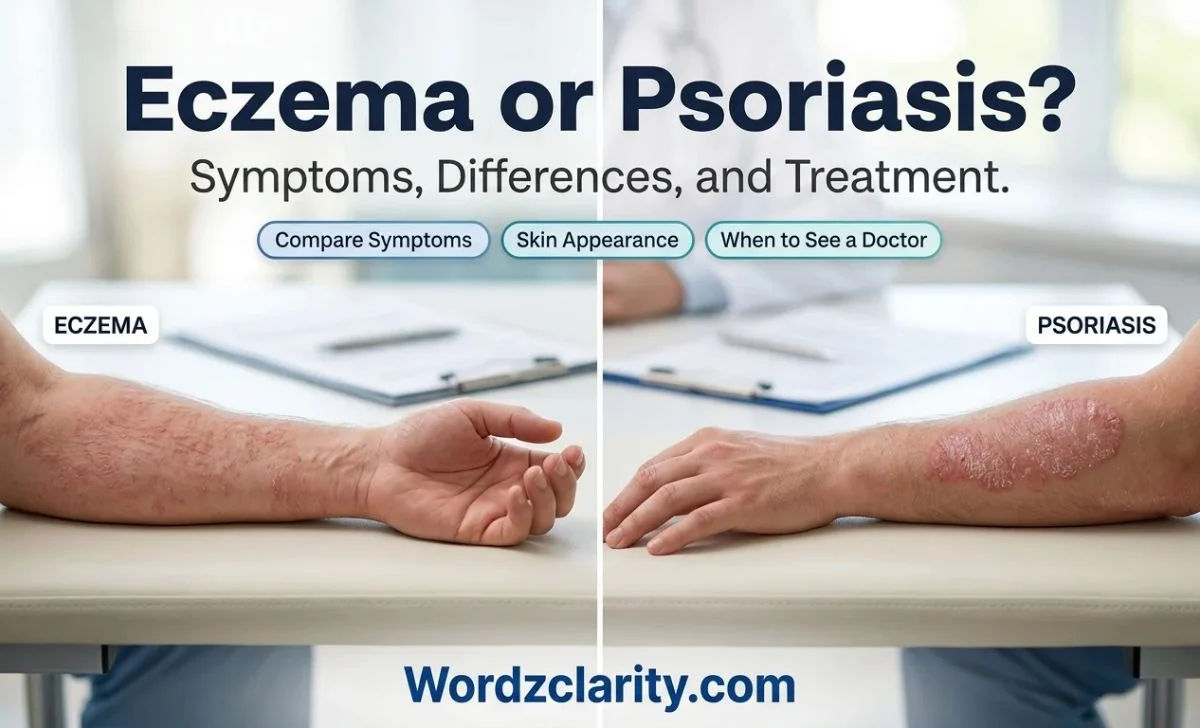
Eczema and psoriasis can both cause red, dry, itchy, irritated skin. At first, they may look so similar that it is hard to tell them apart. Yet they are different skin conditions, and knowing which one you have can help you find the right treatment.
Eczema often causes intense itching and dry, sensitive skin. Psoriasis commonly forms raised patches with a clear edge and a layer of thick, flaky skin. Still, symptoms can vary by skin tone, body area, and severity. A rash that looks like eczema may have another cause, so appearance alone cannot confirm a diagnosis.
If you are searching for eczema or psoriasis pictures, wondering which condition is worse, or looking for the best cream, this guide explains the main differences in simple terms.
You will learn what causes each condition, where rashes tend to appear, whether both can occur together, and which treatments may help. You will also find out whether either condition is contagious and when it is best to see a dermatologist.
Quick Answer: Eczema or Psoriasis?
Eczema usually causes intense itching, dryness, and inflamed skin. Psoriasis often causes raised, well-defined patches with thick scales. Both can look different from person to person, and a healthcare professional may need to examine the skin to tell them apart.
| Feature | Eczema | Psoriasis |
|---|---|---|
| Common appearance | Dry, red, irritated patches | Raised, defined patches with scales |
| Itching | Often intense | Can itch, burn, or feel sore |
| Common locations | Hands, face, neck, elbow creases, and behind knees | Elbows, knees, scalp, and lower back |
| Skin texture | Dry, cracked, or sometimes oozing | Thickened, flaky, or scaly |
| Main factors | Skin barrier problems, immune activity, and triggers | Immune system activity and faster skin-cell turnover |
| Contagious? | No | No |
These are common patterns, not fixed rules. Eczema can become thick and scaly, while psoriasis may look less scaly in some areas. Both conditions can also affect darker skin in ways that are not always shown in online photographs.
Eczema vs. Psoriasis Pictures: What Should You Look For?
When people search for eczema or psoriasis pictures, they usually want to compare the rash on their own skin with a photo online. Pictures can help you understand common patterns, but they cannot confirm which condition you have.
What eczema may look like


Eczema may cause:
- Dry, rough, or inflamed patches.
- Strong itching that can disturb sleep.
- Small bumps or blisters in some types.
- Cracks, scratches, or fluid that leaks from irritated skin.
- Thickened skin after repeated scratching.
The rash often appears in skin folds, such as the inside of the elbows and behind the knees. It may also affect the hands, face, neck, or other areas. The exact pattern depends on the type of eczema and the person’s age.
American Academy of Dermatology
What psoriasis may look like


Psoriasis may cause:
- Raised patches with clear edges.
- Thick, dry skin with white or silvery scales.
- Itching, burning, tenderness, or soreness.
- Cracked skin that may bleed.
- Changes in the fingernails or toenails, such as small dents or separation from the nail bed.
Common areas include the elbows, knees, scalp, and lower back. Some forms affect skin folds or appear as small spots instead of thick plaques. Psoriasis can also affect the nails and joints.
American Academy of Dermatology
Can pictures tell you which condition you have?
Not with certainty. Both conditions can cause redness, dryness, scaling, and itching. Other skin problems can look similar, too.
Skin tone also matters. On lighter skin, inflammation may look pink or red. On darker skin, it may appear brown, purple, gray, or darker than the surrounding skin. Online photos do not always show this range.
Use pictures to learn about possible symptoms, not to diagnose yourself. If a rash persists, spreads, hurts, or does not improve with basic skin care, ask a healthcare professional to examine it.
What Causes Eczema and Psoriasis?
Eczema and psoriasis both involve inflammation and immune-system activity. However, they do not develop in exactly the same way.
What causes eczema?
Eczema is a broad term for several skin conditions. Atopic dermatitis is one of the most common types.
With atopic dermatitis, the skin barrier does not protect and hold moisture as well as it should. This can leave skin dry and more sensitive to irritants. Immune activity also plays a role. Genes, environment, and personal triggers may all affect symptoms.
American Academy of Dermatology
Common eczema triggers include:
- Fragranced soaps, lotions, and detergents.
- Hot showers, heat, and sweating.
- Cold or dry weather.
- Wool or rough fabrics.
- Dust, pollen, or other allergens in some people.
- Stress and poor sleep.
Not everyone reacts to the same triggers. For example, one person may flare after using a scented body wash, while another notices symptoms after sweating or spending time in cold weather.
Eczema is not always caused by an allergy. Avoid cutting out foods or making major diet changes unless a qualified healthcare professional identifies a reason to do so.
What causes psoriasis?
Psoriasis is a long-term inflammatory condition linked to the immune system. The immune system speeds up the production of skin cells. These cells build up on the surface instead of shedding at the usual rate, forming thick patches and scales. Genetics can also increase a person’s chance of developing psoriasis.
American Academy of Dermatology
Possible psoriasis triggers include:
- Stress.
- Some infections, including strep throat.
- Skin injuries, cuts, or sunburn.
- Certain medicines.
- Smoking or heavy alcohol use, which may worsen symptoms in some people.
Triggers differ from person to person. A flare can happen even when someone cannot identify a clear cause.
Eczema vs. psoriasis causes at a glance
| Factor | Eczema | Psoriasis |
|---|---|---|
| Skin barrier | Often weakened, especially in atopic dermatitis | Not the main defining problem |
| Immune system | Inflammation contributes to symptoms | Immune activity drives faster skin-cell growth |
| Genes | Can run in families | Can run in families |
| Irritants | Often trigger or worsen symptoms | Skin injury or irritation can trigger a flare |
| Stress | May worsen symptoms | May worsen symptoms |
These differences help explain why a treatment that works well for one person may not work for another. A clinician can help identify the condition and choose the right approach.
Which Is Worse: Psoriasis or Eczema?
There is no single answer. Neither condition is always worse than the other. The effect depends on how severe the symptoms are, which areas are affected, and how much the condition disrupts daily life.
Eczema can be especially difficult when intense itching causes poor sleep, broken skin, or repeated infections. Scratching may make the rash worse and lead to thickened skin over time.
Psoriasis can be difficult when thick plaques crack, bleed, or cover large areas. It may also affect the scalp and nails. Some people with psoriasis develop psoriatic arthritis, which can cause joint pain, swelling, and stiffness.
American Academy of Dermatology
| Concern | Eczema | Psoriasis |
|---|---|---|
| Itching | Can be severe | May range from mild to severe |
| Sleep problems | Common when itching is intense | Possible when itching or discomfort is severe |
| Cracking or bleeding | Can occur after dryness and scratching | Can occur when plaques crack |
| Nail changes | Less typical | A known feature of some cases |
| Joint symptoms | Not a defining feature | May occur with psoriatic arthritis |
| Daily impact | May affect sleep, comfort, and concentration | May affect comfort, movement, confidence, and daily tasks |
A small patch of either condition may be easy to manage. A widespread or painful rash can be much harder. The label alone does not tell you how serious a person’s symptoms are.
Seek medical advice if symptoms interfere with sleep, keep returning, or fail to improve with suitable care. If you have psoriasis and notice persistent joint pain, swelling, or morning stiffness, tell your healthcare professional. Early assessment of possible psoriatic arthritis matters.
Can You Have Both Eczema and Psoriasis?
Yes. A person can have both eczema and psoriasis, although the conditions may be difficult to distinguish when their signs overlap. The American Academy of Dermatology notes that some people, including children, can have both.
American Academy of Dermatology
For example, someone may have the typical thick plaques of psoriasis on the elbows and also develop itchy eczema on the hands. In other cases, a single rash may not fit the usual pattern of either condition.
A dermatologist may look at:
- The shape, location, and texture of the rash.
- How much it itches or hurts.
- Whether the scalp or nails are affected.
- Personal and family medical history.
- How the rash responds to previous treatment.
Sometimes, an examination is enough. If the diagnosis remains unclear, a clinician may recommend a skin biopsy or other tests based on the suspected cause.
Do not assume that a rash is eczema simply because you already have eczema. A new rash may have a different cause, and the treatment may need to change.
Treatment for Eczema and Psoriasis
Both conditions can often be managed, but treatment depends on the diagnosis, severity, location, and the person’s overall health. A cream that helps eczema may not control psoriasis, and medicines designed for one condition do not always work for the other.
American Academy of Dermatology
How eczema is treated
Eczema care usually aims to protect the skin barrier, ease itching, reduce inflammation, and prevent flares.
Common approaches include:
- Moisturizers: Apply a fragrance-free cream or ointment regularly to reduce dryness and help protect the skin.
- Gentle skin care: Use mild, fragrance-free cleansers and avoid very hot water.
- Trigger management: Notice whether certain soaps, fabrics, weather conditions, or other factors make symptoms worse.
- Prescription creams or ointments: A clinician may recommend a topical corticosteroid or another anti-inflammatory medicine.
- Other treatments: More severe eczema may need prescription medicines that work throughout the body or supervised light therapy.
Moisturizer is a key part of eczema care, but it may not be enough during a significant flare. The right medicine depends on the type of eczema and the area affected.
Cleveland Clinic
How psoriasis is treated
Psoriasis treatment aims to reduce inflammation, soften or remove excess scale, and slow the overproduction of skin cells.
Options may include:
- Moisturizers and emollients: These soften dry skin and may reduce scaling or discomfort.
- Prescription topical medicines: Depending on the case, a clinician may prescribe corticosteroids, vitamin D-based medicines, or other treatments.
- Light therapy: Medically supervised phototherapy may help when psoriasis affects larger areas or does not respond enough to topical care.
- Oral or injectable medicines: Moderate to severe psoriasis may require treatments that act on the immune system.
The best plan depends on the type of psoriasis, how much skin is affected, and whether the nails or joints are involved. There is no single treatment that works for everyone.
American Academy of Dermatology
What can help with both conditions?
Some simple skin-care steps can support comfort in either condition:
- Choose fragrance-free moisturizers.
- Use lukewarm water rather than very hot water.
- Pat skin dry instead of rubbing it hard.
- Avoid scratching or peeling off scales.
- Track possible triggers and flare patterns.
- Follow the treatment instructions given by your healthcare professional.
These steps can ease dryness and irritation, but they do not replace treatment for active inflammation. Avoid using someone else’s prescription cream or applying steroid medicines to sensitive areas without proper advice.
What Is the Best Cream for Eczema and Psoriasis?
The best cream depends on which condition you have. There is no single cream that treats every case of eczema and psoriasis. A moisturizer may help both, but each condition may need a different medicine to control inflammation.
Best cream ingredients for eczema
For dry, itchy eczema, look for a fragrance-free moisturizer with ingredients that help hold moisture in the skin.
Useful options include:
- Petrolatum: Helps seal in moisture and protect dry, cracked skin.
- Ceramides: Help support the skin’s natural protective barrier.
- Glycerin: Attracts water to the skin.
- Colloidal oatmeal: May soothe itching and irritation in some people.
Creams and ointments often protect very dry skin longer than thin lotions. However, the best choice is one you tolerate well and can apply regularly. Stop using a product if it causes a clear increase in irritation.
Cleveland Clinic
Best cream ingredients for psoriasis
For psoriasis, a moisturizer can soften thick scales and reduce dryness. Depending on the diagnosis, a clinician may also recommend a medicine such as:
- A topical corticosteroid to reduce inflammation.
- A vitamin D-based cream or ointment to help control skin-cell growth.
- Salicylic acid to soften and remove scales in suitable cases.
- Other prescription treatments for specific types or locations of psoriasis.
These medicines are not suitable for every person or every body area. For example, some treatments require extra care on the face, in skin folds, or during pregnancy. Ask a healthcare professional which product is appropriate for you.
American Academy of Dermatology
Can you use the same cream for eczema and psoriasis?
You may use the same basic moisturizer for both conditions if it suits your skin. However, you should not assume that a medicated cream prescribed for one will treat the other.
Before choosing a product, consider these points:
- Is the main problem dryness, itching, thick scaling, or inflammation?
- Is the rash on your face, hands, scalp, or another sensitive area?
- Has a clinician confirmed the diagnosis?
- Does the product contain fragrance or another ingredient that irritates your skin?
If you are unsure what is causing the rash, get it checked before trying several medicated products. Treating the wrong condition may delay relief.
Are Eczema and Psoriasis Contagious?
No. Neither eczema nor psoriasis is contagious. You cannot catch either condition by touching someone else’s skin, sharing a seat, hugging, or swimming in the same pool.
American Academy of Dermatology
Eczema develops through factors such as skin barrier problems, immune activity, and genetics. Psoriasis is an inflammatory condition linked to immune activity and faster skin-cell growth. Neither spreads from person to person.
However, broken or scratched skin can sometimes develop a separate infection. If a rash becomes increasingly painful, warm, swollen, or develops pus, seek medical advice. Fever or rapidly spreading redness can also be a warning sign.
You do not need to avoid someone because they have eczema or psoriasis. Both conditions are skin disorders, not something a person can pass to you through ordinary contact.
Common Mistakes When Comparing Eczema and Psoriasis
It is easy to misunderstand these conditions when you rely on a few symptoms or a picture. Avoid these common mistakes.
1. Assuming every itchy rash is eczema
Eczema often causes intense itching, but psoriasis and many other skin conditions can itch too. Itching alone cannot confirm the diagnosis.
Better approach: Look at the full pattern, including the rash’s location, texture, duration, and other symptoms. Ask a clinician if you are unsure.
2. Assuming psoriasis always has silver scales
Thick plaques with silvery scales are common in plaque psoriasis. Other forms may look different, especially in skin folds or on the scalp.
Better approach: Do not rule out psoriasis just because your rash does not match a typical online picture.
3. Choosing a medicated cream based on a photo
Two rashes may look similar but need different treatment. Strong steroid creams and other prescription medicines can cause problems when used incorrectly.
Better approach: Use a simple moisturizer for dryness if it is suitable for your skin, but get advice before using medicated treatments for an undiagnosed rash.
4. Believing one condition is always more serious
The severity of eczema and psoriasis varies. One person’s eczema may be mild, while another person’s symptoms may disrupt sleep. Psoriasis can be limited to a small patch or involve extensive skin and joint problems.
Better approach: Judge the impact of the symptoms, not just the condition’s name.
5. Ignoring symptoms beyond the skin
Psoriasis can affect the nails and joints. Severe eczema can also lead to broken skin and secondary infection.
Better approach: Tell your healthcare professional about nail changes, joint pain, spreading redness, or signs of infection.
When Should You See a Dermatologist?
Consider making an appointment if:
- You cannot tell whether the rash is eczema or psoriasis.
- The rash persists, spreads, or keeps returning.
- Itching or pain interferes with sleep or daily activities.
- Over-the-counter skin care does not help.
- You notice changes in your nails or persistent joint pain.
- The rash affects your face, eyes, genitals, or another sensitive area.
Seek prompt medical care if the rash becomes rapidly worse, is very painful, develops pus, or comes with fever or spreading redness. These symptoms may point to an infection or another problem that needs treatment.
A dermatologist can usually assess the skin and ask about your symptoms and medical history. Sometimes, a small skin sample is needed to help confirm the diagnosis.
American Academy of Dermatology
FAQs
1. How can I tell if I have eczema or psoriasis?
Eczema often causes intense itching, dry skin, and irritation, especially in skin folds. Psoriasis often forms raised patches with clear edges and thick scales, commonly on the elbows, knees, or scalp. These patterns overlap, so a clinician may need to examine your skin.
2. Can eczema turn into psoriasis?
Eczema does not simply turn into psoriasis. They are different conditions, although a person can develop either condition over time or have both. A new or changing rash may need a fresh assessment.
3. Is psoriasis an autoimmune disease?
Psoriasis is an immune-mediated inflammatory condition. Immune activity speeds up skin-cell production, causing cells to build up and form visible patches. Healthcare professionals often describe it as an immune-mediated disease.
4. Can stress make eczema or psoriasis worse?
Yes. Stress may worsen symptoms or contribute to flares in either condition. However, stress is not the only cause. Skin care, treatment, sleep, and managing personal triggers can all be part of a broader plan.
5. Do eczema and psoriasis ever go away permanently?
Both conditions can often be controlled, but they may return after periods of improvement. Some people have long periods with few symptoms. Treatment can reduce flares and improve comfort, even when the condition is not permanently cured.
6. Can children have eczema or psoriasis?
Yes. Both conditions can affect children. Eczema is common in childhood, while psoriasis can also develop at a young age. Because their symptoms can overlap, a healthcare professional can help confirm the diagnosis and choose treatment that is safe for the child’s age.
7. Can diet cure eczema or psoriasis?
No specific diet is a proven cure for both conditions. Some people have individual food-related triggers, but avoiding foods without a clear reason can lead to unnecessary restrictions. Ask a healthcare professional before making major dietary changes, especially for a child.
Conclusion
Eczema and psoriasis can look alike, but they have important differences. Eczema often causes intense itching, dryness, and sensitive skin.
Psoriasis more often forms raised, well-defined patches with thick scales. Their causes also differ: eczema is closely linked to skin barrier problems and inflammation, while psoriasis involves immune activity that speeds up skin-cell growth.
Neither condition is contagious, and a person can have both. Neither is always worse than the other. The effect depends on the severity of symptoms, the areas affected, and whether the condition disrupts sleep, daily activities, or joint health.
If you are comparing eczema or psoriasis pictures, use them to learn about common signs rather than to diagnose your own rash. A gentle, fragrance-free moisturizer may help with dryness in either condition, but medicated creams should match the diagnosis. There is no single cream that works for everyone.
If your rash persists, worsens, or causes significant discomfort, consult a healthcare professional or dermatologist. The right diagnosis can help you choose a safer treatment plan and manage symptoms more effectively.
Read More Blogs
- Premise or Premises: Meaning, Difference, and Correct Usage
- Latter or Former: Meaning, Difference, Grammar, and Examples
- Specialty or Speciality: Meaning, Difference, and Correct Usage
- Appendixes or Appendices: A Clear Guide to the Plural of Appendix