When writing in English, three small words appear everywhere: and, or, and but. They are easy to recognize, but using the right one can sometimes be confusing.
Each word connects ideas in a different way, so choosing the wrong conjunction can change the meaning of a sentence.
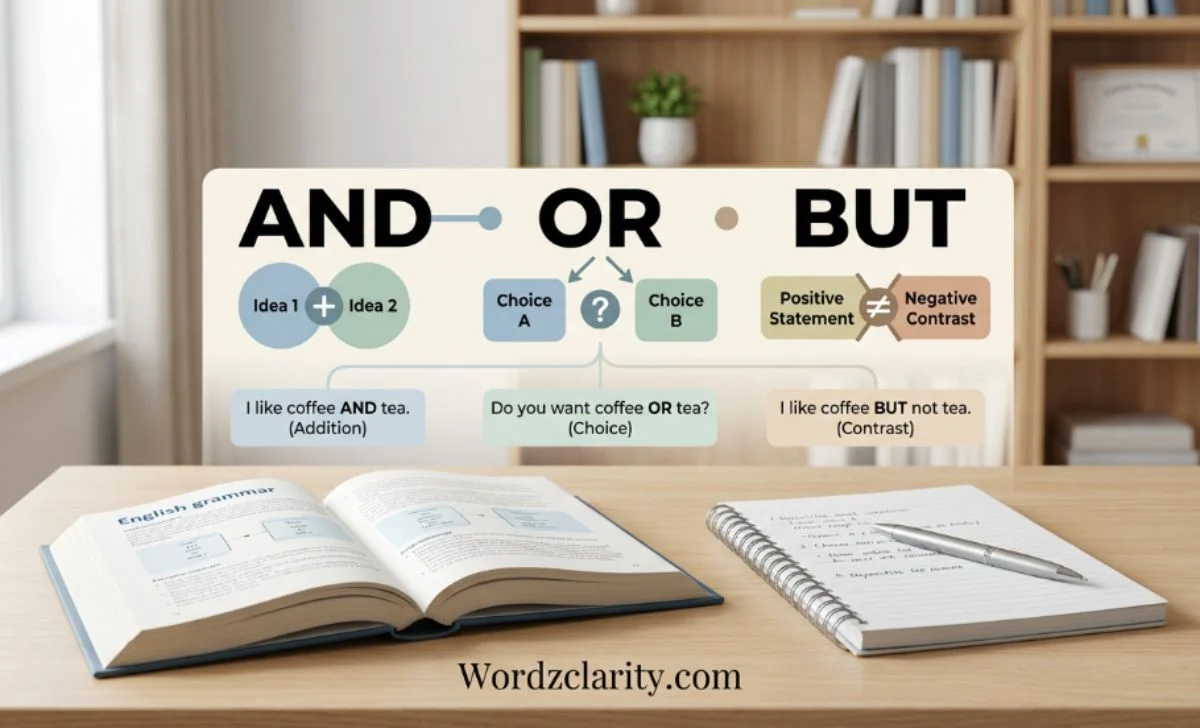
And adds information, or presents a choice or alternative, and but introduces a contrast. These words are also important parts of English grammar because they are coordinating conjunctions and members of the FANBOYS group.
This guide explains the difference between and, or, and but, how to use each one, when to use commas, and how they work in sentences. You will also find practical examples, common mistakes, exercises, and simple rules that make these conjunctions easier to use correctly.
Quick Answer
And, or, and but are coordinating conjunctions, but they serve different purposes.
| Word | Main use | Example |
|---|---|---|
| And | Adds information | I bought bread and milk. |
| Or | Shows a choice | Do you want tea or coffee? |
| But | Shows contrast | I was tired, but I continued working. |
A quick memory rule is:
- And = addition
- Or = alternative
- But = contrast
These three meanings cover most everyday uses.
What Are And, Or, and But?
And, or, and but are coordinating conjunctions. A coordinating conjunction connects words, phrases, or clauses that have the same grammatical importance.
They are three of the seven conjunctions represented by FANBOYS:
For, And, Nor, But, Or, Yet, So
For example:
Sarah bought apples and oranges.
Here, and connects two nouns.
You can call me or send an email.
Here, or connects two choices.
I wanted to go, but I was busy.
Here, but connects two contrasting ideas.
The important point is that the three words do not have interchangeable meanings.
How to Use And
Use and when you want to add one idea, item, person, or action to another.
Joining words
Tom and James are friends.
I bought a notebook and a pen.
Joining phrases
She went to the store and bought some bread.
He opened the door and walked inside.
Joining complete clauses
I finished my work, and I went home.
The word and tells the reader that the second idea is being added to the first.
More examples
- She speaks English and Spanish.
- We need chairs and tables.
- The room was clean and comfortable.
- He studied hard and passed the test.
If the meaning is essentially “this plus that,” and is usually the correct choice.
How to Use Or
Use or when you present a choice, alternative, or possibility.
Showing a choice
Would you like tea or coffee?
Do you want to walk or take the bus?
Showing possibilities
We may go to the park or stay home.
You can finish the work today or tomorrow.
Either…or
Or commonly appears with either:
You can either call me or send a message.
Other examples include:
- Either Sarah or Mike will help you.
- You can either stay here or go home.
- We will either eat at home or go out.
The basic question to ask is:
Am I presenting alternatives?
If the answer is yes, or is usually the appropriate conjunction.
How to Use But
Use but when the second idea contrasts with, limits, or differs from the first.
I wanted to go, but I was too tired.
The first part makes the reader expect that the person will go. The second part gives a different result.
More examples:
- She is young, but very experienced.
- I studied hard, but I failed the test.
- The restaurant was small, but the food was excellent.
- He was tired, but he continued working.
Unlike and, which adds information, but tells the reader that there is an important difference between the ideas.
And vs. Or vs. But
The clearest way to understand and, or, and but is to compare the relationship they create.
| Conjunction | Relationship | Example |
|---|---|---|
| And | Addition | Jack bought a shirt and a jacket. |
| Or | Alternative | Jack can buy a shirt or a jacket. |
| But | Contrast | Jack bought a shirt, but not a jacket. |
Consider another set:
She likes tea and coffee.
This normally means she likes both.
She likes tea or coffee.
This presents tea and coffee as alternatives.
She likes tea, but she does not like coffee.
This creates a contrast.
So, when deciding between and vs. or vs. but, focus on the meaning rather than the appearance of the sentence.
And vs. Or
The difference between and and or is especially important when talking about choices.
And generally means that both things are included:
Bring a notebook and a pen.
Or presents one alternative instead of another:
Bring a notebook or a pen.
A useful test is:
- Do I mean both? → and
- Do I mean one alternative or another? → or
This simple distinction solves many common and or but grammar questions.
And vs. But
Use and to connect related information. Use but when the second idea contrasts with the first.
Compare:
The house is small and comfortable.
The second description adds information.
The house is small, but comfortable.
The second idea is presented as somewhat unexpected because small and comfortable may seem less expected together.
Another example:
He is intelligent and hardworking.
Both qualities are being added.
He is intelligent, but sometimes careless.
The second idea changes or limits the first.
Or vs. But
Or presents alternatives, while but presents contrast.
Compare:
You can stay here or leave.
This gives two choices.
You can stay here, but you cannot leave early.
The second part places a limitation on the first.
This distinction is useful in both conversation and formal writing because changing the conjunction can change the relationship between the ideas.
Comma Before And, Or, and But
One of the most common questions is whether you need a comma before and, or, or but.
The answer depends on what the conjunction is joining.
When a coordinating conjunction joins two independent clauses, a comma is generally used before it.
I finished the report, and I sent it to my manager.
You can call me, or you can send an email.
I wanted to attend, but I was busy.
Each side can stand as a complete sentence.
However, when the conjunction joins simple words or phrases, a comma is usually not needed.
I bought bread and milk.
Would you like tea or coffee?
She is tired but happy.
Quick comma guide
| Sentence | Comma | Reason |
|---|---|---|
| I bought bread and milk. | No | Joins nouns |
| She sings and dances. | No | Joins verbs |
| Call me or text me. | No | Joins alternatives |
| I was tired, but I continued. | Yes | Joins independent clauses |
| He studied hard, and he passed. | Yes | Joins independent clauses |
Do not put a comma before every and, or, or but. First check what the conjunction is connecting.
Can You Start a Sentence With And, Or, or But?
Yes. It is acceptable to begin a sentence with and, or, or but, especially in conversational, creative, journalistic, and modern general writing.
For example:
I wanted to call you. But I was too busy.
We could take the train. Or we could drive.
The task was difficult. And we had very little time.
However, this should be a deliberate writing choice. Beginning too many sentences with conjunctions can make a paragraph feel repetitive or choppy.
In formal writing, you can often combine closely related ideas instead:
I wanted to call you, but I was too busy.
The best choice depends on the style and rhythm of the writing.
Common Mistakes With And, Or, and But
1. Using and for a choice
Would you like tea and coffee?
If the person is supposed to choose one, or is clearer:
Would you like tea or coffee?
2. Using or when both things are intended
She speaks English or Spanish.
If she speaks both languages, write:
She speaks English and Spanish.
3. Using and instead of but
I was tired, and I finished the work.
If the point is that finishing was unexpected despite being tired, but communicates the relationship more clearly:
I was tired, but I finished the work.
4. Adding an unnecessary comma
I bought apples, and oranges.
Because and only joins two nouns here, the comma is normally unnecessary.
Better:
I bought apples and oranges.
5. Forgetting a comma between independent clauses
I was tired but I finished the work.
When but joins two independent clauses, standard punctuation generally calls for a comma:
I was tired, but I finished the work.
Real-World Examples
These conjunctions appear in almost every type of English writing.
Please review the document and send your comments.
You can reply to this email or call our office.
We received your request, but we need more information.
Business writing
The company sells software and provides support.
Customers can pay online or by bank transfer.
Sales increased, but profits remained stable.
Academic writing
The study examines language use and communication patterns.
Participants could respond online or in person.
The sample was small, but the results were useful.
Everyday conversation
Do you want pizza or burgers?
I called him, but he did not answer.
We went to the store and bought some food.
Websites and social media
Create an account and start using the service.
Sign in or create a new account.
The event was short, but it was amazing.
Related Conjunction Patterns
Understanding these three words also helps with common paired conjunctions.
Both…and adds two related elements:
She is both smart and creative.
Either…or presents two alternatives:
You can either stay or leave.
Neither…nor connects two negative choices:
He likes neither tea nor coffee.
Not only…but also adds emphasis:
She is not only intelligent but also hardworking.
These structures build on the same basic ideas of addition, alternatives, and relationships between ideas.
Practice: Choose And, Or, or But
Choose the correct conjunction.
- I wanted to go, ___ I was too tired.
- Do you want tea ___ coffee?
- Sarah bought apples ___ oranges.
- You can call me ___ send an email.
- He studied hard, ___ he did not pass.
- We need chairs ___ tables.
- Would you like to stay ___ leave?
- The room was small, ___ it was comfortable.
Answers
- but
- or
- and
- or
- but
- and
- or
- but
The rule is simple: and adds, or offers alternatives, and but shows contrast.
Practical Tips for Better Writing
Keep these points in mind when choosing between the three conjunctions:
- Identify the relationship first. Decide whether you are adding, choosing, or contrasting.
- Use and for inclusion. It normally connects things that belong together.
- Use or for alternatives. It signals a choice or possibility.
- Use but for contrast. It shows a difference, limitation, or unexpected result.
- Check the sentence structure. Two independent clauses may require a comma before the conjunction.
- Do not add commas automatically. Words joined by a conjunction usually do not need one.
- Read the sentence again. If the meaning sounds wrong, reconsider the conjunction.
- Keep formal writing clear. Simple conjunctions are often better than unnecessarily complicated alternatives.
FAQs
1. What are and, or, and but called?
They are coordinating conjunctions. They connect words, phrases, and clauses of equal grammatical importance.
2. What is the difference between and, or, and but?
And adds information, or presents an alternative, and but shows contrast.
3. Are and, or, and but FANBOYS?
Yes. They are three of the seven coordinating conjunctions included in the mnemonic FANBOYS.
4. Do you always put a comma before and, or, and but?
No. A comma is generally used when one of these conjunctions joins two independent clauses. It is usually unnecessary when joining individual words or simple phrases.
5. Can you start a sentence with and or but?
Yes. Starting a sentence with these conjunctions is acceptable when it improves emphasis, flow, or style.
6. When should I use or instead of and?
Use or when you mean alternatives or choices. Use and when you mean that the items or ideas are included together.
7. Which conjunction shows contrast?
But is the most common of the three for showing contrast between two ideas.
Conclusion
And, or, and but are simple words, but they play an important role in clear English writing. And adds information, or gives a choice or alternative, and but connects ideas that contrast with each other. Understanding these three basic relationships makes it much easier to choose the correct conjunction.
Remember the simple rule: and = addition, or = alternative, but = contrast. Also pay attention to punctuation. When one of these conjunctions joins two independent clauses, a comma is generally placed before it. When it joins words or short phrases, a comma is usually not needed.
Whether you are writing an email, completing a worksheet, answering an academic question, or having a conversation, these rules will help you create clearer sentences. Focus on the meaning first, then choose the conjunction that expresses that relationship naturally.
Read More Blogs:
- High School or Highschool: Which Spelling Is Correct?
- Analysed or Analyzed: The Difference Between These Spellings
- Enquiry vs Inquiry: The Complete Guide to Meaning and Usage