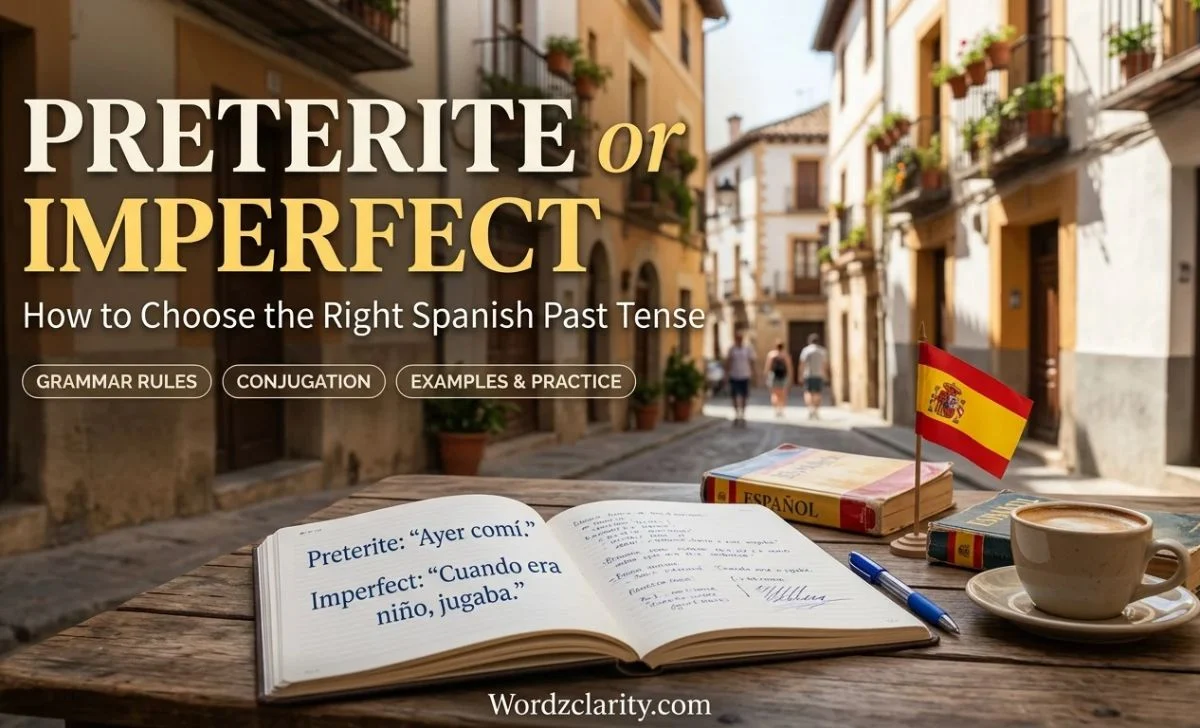
If you have ever tried to tell a story in Spanish and stopped to wonder whether to use hablé or hablaba, you are not alone. Both forms refer to the past, but they do not always mean the same thing.
Imagine telling a friend about your childhood. You might say, Jugaba al fútbol todos los días (I used to play soccer every day). But if you are talking about yesterday’s game, you might say, Jugué al fútbol ayer (I played soccer yesterday).
The difference seems small, yet it changes how your listener understands the story.
The preterite and imperfect are two of the most important Spanish past tenses. Once you understand how they work, you can describe memories, talk about past routines, explain what happened, and tell stories more naturally. You will also find it easier to understand Spanish books, conversations, and lessons.
In this guide, we will look at the meaning of each tense, how to conjugate common verbs, and when to use them together. You will also find examples involving a veces, telling the time, and the word segundo, along with a short quiz to test what you have learned.
Quick Answer: Preterite or Imperfect?
The main difference is how you present an action in the past.
Preterite: Use it to report an event as complete. Ayer compré un libro. I bought a book yesterday.
Imperfect: Use it for past habits, descriptions, and actions that were in progress. Cuando era niño, leía mucho. When I was a child, I used to read a lot.
Here is another example:
Yo cocinaba cuando llegó mi hermano.
I was cooking when my brother arrived.
The word cocinaba describes what was happening. The word llegó tells us what happened next.
That is the basic idea. The preterite often tells the main event, while the imperfect gives us the background. However, the choice depends on the meaning of the sentence, not just on whether an action has ended.
What Do Preterite and Imperfect Mean?
Spanish uses both tenses to talk about the past. English often uses the same simple past form for situations that Spanish expresses differently.
For example, “I lived in Madrid” could be translated in more than one way.
- Viví en Madrid durante tres años. — I lived in Madrid for three years.
- Vivía en Madrid cuando conocí a Ana. — I was living in Madrid when I met Ana.
In the first sentence, the speaker presents the three-year period as a complete part of their life. In the second, living in Madrid provides the background for another event.
Neither tense automatically means that an action lasted a short or long time. The speaker’s focus matters more than the length of the action.
What Is the Preterite?
The preterite presents a past action as a complete event. It is common when you tell someone what happened, describe a sequence of events, or report a particular action.
Examples:
- Ayer fui al mercado. — I went to the market yesterday.
- María llamó a su madre. — María called her mother.
- Terminamos el proyecto el lunes. — We finished the project on Monday.
- El tren salió a las ocho. — The train left at eight.
These sentences focus on events rather than on what life was like at the time.
What Is the Imperfect?
The imperfect describes a past habit, condition, or action in progress. It often helps explain the circumstances around an event.
Examples:
- De niño, vivía en un pueblo pequeño. — As a child, I lived in a small town.
- Mi padre caminaba al trabajo. — My father used to walk to work.
- Hacía frío aquella noche. — It was cold that night.
- Los niños dormían. — The children were sleeping.
The imperfect does not mean that these situations lasted forever. It simply describes them without focusing on them as complete events.
When to Use the Preterite
Think about the last time you told someone what happened during your day. You probably listed events: you woke up, went to work, met a friend, or finished a task. In Spanish, the preterite is often the natural choice for these events.
1. To Talk About Completed Events
Use the preterite when you present an action as complete.
- Compré unos zapatos nuevos. I bought some new shoes.
- El profesor explicó la regla. The teacher explained the rule.
- Mi hermana preparó la cena. My sister prepared dinner.
You are reporting what happened, not describing an ongoing routine.
2. To Describe a Sequence of Events
The preterite is useful when several actions happen one after another.
Me levanté, desayuné y salí de casa.
I got up, ate breakfast, and left home.
Each verb moves the story forward. You will often see this pattern in personal stories, news reports, and accounts of past events.
3. To Mention a Specific Number of Actions
Repeated actions can take the preterite when the speaker presents them as a completed group.
- Llamé tres veces. I called three times.
- Visitamos dos museos durante el viaje. We visited two museums during the trip.
- El equipo ganó cuatro partidos. The team won four matches.
Compare the first example with Llamaba a mi madre todos los días (I used to call my mother every day). The imperfect describes a routine, while the preterite counts completed calls.
4. To Show That Something Started or Stopped
Some verbs in the preterite highlight a change or a particular point in an event.
- La película empezó. The movie started.
- Dejó de llover. It stopped raining.
- El bebé se durmió. The baby fell asleep.
These sentences focus on the change itself.
When to Use the Imperfect
The imperfect comes up naturally when you describe your childhood, explain how things used to be, or set the scene for a story.
1. For Past Habits
Use the imperfect for actions that happened regularly over a period in the past.
- Jugaba al fútbol después de clase. I used to play soccer after class.
- Mi abuela hacía pan los domingos. My grandmother used to make bread on Sundays.
- Íbamos a la playa cada verano. We used to go to the beach every summer.
The speaker is describing a pattern, not reporting one particular trip or game.
2. For Actions That Were in Progress
The imperfect can describe what someone was doing when another event occurred.
- Estudiaba cuando me llamaste. I was studying when you called me.
- Mi madre cocinaba mientras yo limpiaba. My mother was cooking while I was cleaning.
- Los niños jugaban en el jardín. The children were playing in the garden.
The action may have continued after the moment described. The imperfect keeps the focus on what was happening.
3. For Descriptions
When you describe a place, person, or situation in the past, the imperfect is often appropriate.
- La casa era grande. The house was big.
- Mi profesor era muy amable. My teacher was very kind.
- Las calles estaban vacías. The streets were empty.
- Hacía mucho calor. It was very hot.
These details help your listener picture the scene.
4. For Age and Time
Spanish normally uses the imperfect to say how old someone was or what time it was.
- Tenía doce años. — I was twelve years old.
- Era la una. — It was one o’clock.
- Eran las tres. — It was three o’clock.
- Era medianoche. — It was midnight.
For example:
Eran las tres cuando salimos.
It was three o’clock when we left.
Eran tells us the time. Salimos reports the departure.
5. For Past Feelings and Conditions
The imperfect is common with verbs that describe how someone felt, what they wanted, or what they knew.
- Estaba cansado. — I was tired.
- Quería descansar. — I wanted to rest.
- Tenía miedo. — I was afraid.
- No sabía la respuesta. — I did not know the answer.
The preterite can also appear with some of these verbs when the speaker wants to highlight a change or a particular event. The meaning of the sentence is what matters.
Preterite vs Imperfect Examples
Seeing the two tenses side by side is often more useful than learning the rules separately.
| Preterite | Imperfect |
|---|---|
| Ayer estudié español. — I studied Spanish yesterday. | Estudiaba español cada tarde. — I used to study Spanish every afternoon. |
| La puerta se abrió. — The door opened. | La puerta estaba abierta. — The door was open. |
| Llegó a las ocho. — He or she arrived at eight. | Eran las ocho. — It was eight o’clock. |
| Compré un coche. — I bought a car. | Tenía un coche. — I had a car. |
| Llamé dos veces. — I called twice. | Llamaba cada noche. — I used to call every night. |
Notice that the imperfect is not simply the tense for long actions. A person might live somewhere for years and still use the preterite if they present that period as a completed chapter.
What Happens When Both Tenses Appear Together?
Consider this sentence:
Estaba lloviendo cuando llegamos a casa.
It was raining when we arrived home.
- Estaba lloviendo describes the weather at that moment.
- Llegamos reports the event of arriving.
Here are a few more examples:
- Dormía cuando sonó el teléfono. — I was sleeping when the phone rang.
- Hacía frío cuando salimos. — It was cold when we left.
- La gente bailaba cuando empezó la música. — People were dancing when the music started.
A useful way to think about it is this: the imperfect gives the listener the scene, and the preterite tells what happened in that scene.
Preterite vs Imperfect Conjugations
The endings become easier to learn once you recognize the three main verb groups: -ar, -er, and -ir.
Regular Preterite Endings
| Subject | Hablar (to speak) | Comer (to eat) | Vivir (to live) |
|---|---|---|---|
| yo | hablé | comí | viví |
| tú | hablaste | comiste | viviste |
| él/ella/usted | habló | comió | vivió |
| nosotros/as | hablamos | comimos | vivimos |
| vosotros/as | hablasteis | comisteis | vivisteis |
| ellos/ellas/ustedes | hablaron | comieron | vivieron |
Remember the accents in hablé, habló, comí, and comió. They are part of the correct spelling.
Regular Imperfect Endings
| Subject | Hablar (to speak) | Comer (to eat) | Vivir (to live) |
|---|---|---|---|
| yo | hablaba | comía | vivía |
| tú | hablabas | comías | vivías |
| él/ella/usted | hablaba | comía | vivía |
| nosotros/as | hablábamos | comíamos | vivíamos |
| vosotros/as | hablabais | comíais | vivíais |
| ellos/ellas/ustedes | hablaban | comían | vivían |
The imperfect is fairly regular. The main difference is that -er and -ir verbs share the same endings.
For example, comía can mean “I was eating” or “I used to eat,” depending on the context. Vivía can mean “I was living” or “I used to live.”
The Three Irregular Imperfect Verbs
Most imperfect verbs follow the regular patterns above. The three main exceptions are ser, ir, and ver.
| Subject | Ser (to be) | Ir (to go) | Ver (to see) |
|---|---|---|---|
| yo | era | iba | veía |
| tú | eras | ibas | veías |
| él/ella/usted | era | iba | veía |
| nosotros/as | éramos | íbamos | veíamos |
| vosotros/as | erais | ibais | veíais |
| ellos/ellas/ustedes | eran | iban | veían |
Examples:
- Era tímido cuando era niño. — He was shy when he was a child.
- Íbamos a la escuela juntos. — We used to go to school together.
- Veía las montañas desde mi ventana. — I could see the mountains from my window.
Common Irregular Preterite Forms
Several common verbs have irregular preterite forms. These are worth learning because they appear often in everyday Spanish.
| Infinitive | Yo | Él/ella/usted | Ellos/ellas/ustedes |
|---|---|---|---|
| ser / ir | fui | fue | fueron |
| tener | tuve | tuvo | tuvieron |
| estar | estuve | estuvo | estuvieron |
| hacer | hice | hizo | hicieron |
| poder | pude | pudo | pudieron |
| poner | puse | puso | pusieron |
| decir | dije | dijo | dijeron |
| venir | vine | vino | vinieron |
The preterite forms of ser and ir are identical, so the rest of the sentence tells you which verb is meant.
- Fui al banco. — I went to the bank.
- Fui profesor. — I was a teacher.
Is “A Veces” Preterite or Imperfect?
A veces means “sometimes.” It often appears with the imperfect when someone describes a past habit, but it does not require that tense every time.
For example:
Cuando era niño, a veces jugaba solo.
When I was a child, I sometimes played alone.
The sentence describes something that happened from time to time during childhood.
Now consider:
Durante aquella semana, a veces llegué tarde.
During that week, I arrived late sometimes.
The preterite can work here because the speaker presents the occurrences within a defined period as a completed set. Depending on the intended emphasis, a speaker could also use the imperfect.
The important point is that a veces does not choose the tense for you. Look at what you want to say about the action.
Is “Time” Preterite or Imperfect?
If you are asking how to tell the time in Spanish, the imperfect is normally used to describe the time in the past.
- Era la una. — It was one o’clock.
- Eran las dos. — It was two o’clock.
- Eran las seis cuando llegué. — It was six when I arrived.
But a past event that happened at a particular time often takes the preterite:
La clase empezó a las nueve.
The class started at nine.
The time phrase identifies when the event happened; the verb empezó reports the event itself.
Time words do not always determine the tense. For instance:
Ayer hacía mucho frío.
It was very cold yesterday.
Although ayer means “yesterday,” hacía is imperfect because the sentence describes the weather.
Is “Segundo” Preterite or Imperfect?
The word segundo does not determine which past tense to use. It can mean “second” or refer to a unit of time. The verb and the full sentence decide the tense.
Compare these examples:
- El segundo partido terminó a las cinco. — The second match ended at five.
- Era el segundo día del viaje. — It was the second day of the trip.
- Esperé dos segundos. — I waited two seconds.
- El reloj avanzaba segundo a segundo. — The clock was moving forward second by second.
The first and third sentences use the preterite to report completed events. The other two use the imperfect to describe a situation or an ongoing process.
So, do not treat segundo as a signal word. Focus on the action the sentence describes.
Common Mistakes to Avoid
Even when you know the endings, it is easy to choose the wrong tense. These are a few mistakes worth watching for.
Using the preterite for every past habit
For a regular childhood routine, Cuando era niño, jugaba al fútbol todos los días is usually more natural than jugué. The imperfect presents the activity as a habit.
Assuming long actions always need the imperfect
Viví en Madrid durante cinco años is correct when you present those five years as a completed period. Duration alone does not require the imperfect.
Choosing a tense only because of a signal word
Ayer often appears with the preterite, but Ayer hacía frío is correct. The sentence describes the weather rather than reporting a single event.
Forgetting accents
The difference between hablo and habló matters.
Confusing the preterite forms of ser and ir
Both verbs use forms such as fui and fue. Read the rest of the sentence to understand whether the meaning is “was” or “went.”
Preterite or Imperfect Quiz
Choose the correct form in each sentence. Try answering before looking at the explanations.
1. Cuando era niño, ___ al fútbol todos los días.juguéjugaba
2. Ayer María ___ una carta.escribíaescribió
3. Nosotros ___ cuando sonó la alarma.dormíamosdormimos
4. ___ las tres cuando llegué.FueronEran
5. El tren ___ a las seis.salíasalió
6. Mi abuela a veces ___ pan los domingos.preparópreparaba
7. Durante el viaje, nosotros ___ dos museos.visitábamosvisitamos
8. La casa ___ pequeña y tenía un jardín.fueera
Check answers
If you missed a few, look at the meaning of each sentence before reviewing the verb ending. Ask yourself whether it describes a habit, gives background information, or reports an event. That approach will help you more than memorizing signal words alone.
FAQs
1. Is the preterite the same as the simple past in English?
Not exactly. English often uses the simple past where Spanish uses either the preterite or imperfect. Spanish makes a distinction based on how the speaker presents the past action.
2. Can one sentence use both tenses?
Yes. In Leía cuando llegó mi amigo, leía describes the ongoing action and llegó reports the event that happened during it.
3. Does “siempre” always require the imperfect?
No. Siempre means “always,” but the full context matters. It often accompanies the imperfect for past habits, though the preterite can describe repeated actions within a completed period.
4. Which tense should I use for past emotions?
The imperfect is common for ongoing feelings or states, as in Estaba triste (I was sad) or Quería descansar (I wanted to rest). The preterite can also express a change in state with some verbs.
5. How should I practice these tenses?
Write a few pairs of sentences about your own life. Use the preterite to report something that happened yesterday and the imperfect to describe what you used to do as a child. Then combine the sentences into a short story.
6. Do Spanish speakers use the same rules in every country?
The basic distinction between the preterite and imperfect is shared across Spanish-speaking regions. Some verb forms and everyday expressions vary by region, but the core use of these two tenses remains broadly consistent.
Conclusion
The easiest way to understand the preterite and imperfect is to pay attention to what you want your sentence to do. If you are telling someone what happened, the preterite is often the right choice. If you are describing a past routine, setting the scene, or explaining what was happening, the imperfect will often fit better.
You do not need to rely on a list of signal words every time. Words such as ayer, siempre, and a veces can offer clues, but the meaning of the full sentence matters more. That is why ayer hacía frío uses the imperfect, while ayer compré un libro uses the preterite.
Start with common verbs and simple sentences. Practice describing your childhood, telling a story about yesterday, and explaining what you were doing when something happened. Review the regular endings and learn common irregular forms as you meet them.
With regular practice, choosing between these tenses becomes less about guessing and more about expressing exactly what you mean.
Read More Blogs
- Ashland or Weather: What to Expect by Month, Season & Year
- Jobs in Bend, Oregon: Hiring Now, Part-Time Jobs & Career Tips
- Kyoto or Osaka: Which City Should You Visit in Japan?
- CEO or COO: Differences in Roles, Responsibility, Salary & Power