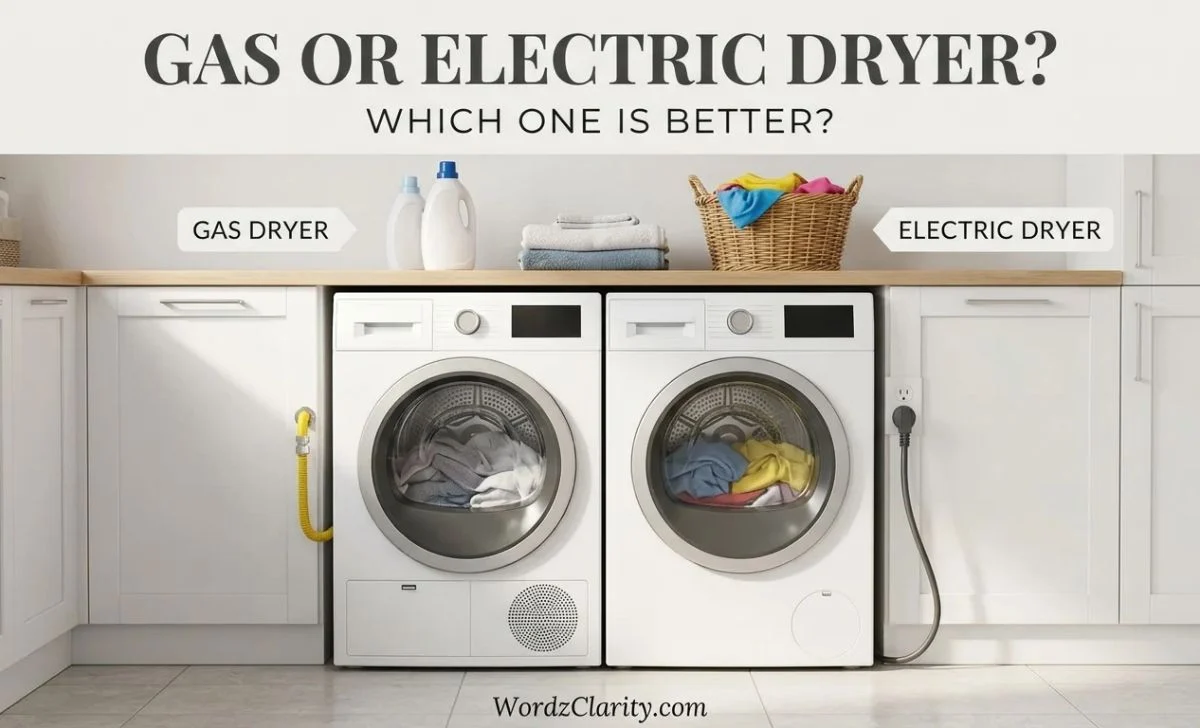
Your old dryer just died. The repair guy says it’s not worth fixing. Now you are standing in an appliance aisle, staring at two nearly identical machines.
One runs on gas. One runs on electricity. Which one should you buy?
Short answer: If your laundry room already has a gas hookup, a gas dryer usually costs less to run and dries faster. If it doesn’t, an electric dryer is almost always the smarter buy.
This guide breaks down price, installation, running costs, speed, safety, and lifespan. You will also meet a third option that may beat both.
Gas or Electric Dryer: The Quick Answer
Start with one question: what hookup does your laundry room have today?
- Gas line already there: Gas is usually the better long-term deal.
- Only a 240-volt outlet: Electric wins on total cost.
- No vent and tight space: A ventless electric heat pump dryer may fit best.
Most people keep the hookup they already have. That is usually the right call.
How Much Does Each Dryer Cost to Buy?
Electric dryers cost a bit less at the register.
Multiple appliance guides put the gap at about $50 to $100 for the same model. Consumer Reports says gas dryers cost $50 to $150 more on average.
CNET’s buying guide, cited by Direct Energy, gives typical price ranges:
| Dryer type | Typical price range |
|---|---|
| Electric | $500 to $1,800 |
| Gas | $600 to $1,900 |
The extra money pays for the gas valve and burner assembly inside the machine.
How Much Does Installation Cost?
Here is where the real difference shows up.
Electric Dryer Installation
If you have a working 240-volt outlet, you plug it in and level it. Done.
No outlet? An electrician must add one. That raises the bill, especially in older homes.
Gas Dryer Installation
A gas dryer needs three things:
- A gas line with a shut-off valve nearby
- A standard 120-volt outlet
- A vent to the outside
HomeAdvisor says a full gas dryer installation averages $760 to $1,550. That is mostly when work is needed beyond a simple hookup. Its cost breakdown shows:
- New gas line: $260 to $800
- Dryer vent installation: $140 to $600
- Gas valve installation: $200 to $500
With an existing gas line, installation takes about one to two hours. A licensed pro should always connect gas.
The Bottom Line on Upfront Costs
If you must add a gas line, the extra cost can wipe out years of savings. If the line already exists, the extra cost is small.
Which Dryer Costs Less to Run?
Gas usually wins on running cost. Natural gas typically costs less than electricity for the same heat.
But published numbers vary, because rates and assumptions differ. Here is a snapshot from recent guides:
| Source | Gas | Standard electric | Heat pump |
|---|---|---|---|
| Per load (appliance cost guide) | about $0.38 | about $0.54 | about $0.18 |
| Per year, 5 loads a week (EIA-based guide) | about $64 | about $133 | about $42 |
The two guides use different assumptions, which is why the yearly totals differ. Treat the numbers as ranges, not promises.
What the Numbers Mean in Real Life
Say you do five loads a week. A gas dryer might save you roughly $50 to $70 a year over a standard electric one at national average rates.
That is helpful. It is not life-changing. At 8 or more loads a week, the gap grows.
How to Check Your Own Cost
Your local rates matter most. Try this quick method.
- Find your electricity price per kWh on your bill.
- Multiply it by about 3 to 4 kWh, a typical load for a standard electric dryer.
- Find your gas price per therm.
- Multiply it by about 0.25 therm, the figure one guide uses for a typical gas load. Add a few cents for the motor.
- Compare the two numbers.
If gas is expensive where you live, the advantage can shrink fast. Direct Energy warns that high fuel prices can erase the long-term savings.
Which Dryer Dries Faster?
Gas dryers usually win here too.
A gas burner heats the drum quickly. That helps with heavy loads like towels and jeans. If you run load after load, the time saved adds up.
One commercial dryer guide claims gas dries 25 to 30 percent faster. That figure comes from commercial machines, so home results may differ. Still, most guides agree: gas is quicker.
Which Dryer Is Safer?
Both are safe when installed and maintained well. But the risks differ.
Gas Dryer Risks
Gas models have two special risks:
- Gas leaks from lines or connections
- Carbon monoxide leaks from poor venting
Carbon monoxide is colorless, odorless, and deadly. Gas dryers must always vent outside.
Safety steps:
- Hire a licensed pro to install it.
- Put a carbon monoxide detector near the laundry area.
- If the alarm sounds, get everyone out and call your gas utility or fire department.
Electric Dryer Risks
Electric dryers avoid gas and carbon monoxide risks. They need a proper 240-volt circuit and a safe cord connection.
Lint Is a Risk for Both
Lint buildup is a leading cause of dryer fires, and it affects gas and electric models alike.
- Clean the lint trap after every load.
- Have the vent cleaned regularly. Professional cleaning typically costs $100 to $200 per visit.
Which Dryer Lasts Longer?
Both last a long time.
HomeAdvisor says most gas dryers last 10 to 15 years with good care. Angi puts the average at about 14 years for electric and 13 for gas.
The gap is small. Maintenance matters far more than fuel type.
The Third Option: Heat Pump Dryers
Some buyers skip the gas-vs-electric debate completely.
A heat pump dryer is an electric dryer that recycles heat. It uses roughly 1 kWh per load, per one cost guide. That is far less than a standard electric model.
Pros of Heat Pump Dryers
- Lowest running cost in several guides
- No outside vent needed
- Gentler on clothes
Cons of Heat Pump Dryers
- Higher purchase price
- Slower cycles, sometimes around three hours
- Not ideal if you do many loads a day
One guide estimates a heat pump dryer saves about $91 a year over a standard electric one at 19 cents per kWh. If you plan to keep it 10 years or more, it can pay off.
What About the Environment?
The picture is mixed.
- Gas dryers burn fossil fuel in your home.
- Electric dryers can run on renewable power, depending on your grid.
Heat pump models cut energy use the most. That helps no matter where your power comes from.
Gas vs Electric Dryer at a Glance
| Factor | Gas dryer | Electric dryer |
|---|---|---|
| Purchase price | $50 to $150 more | Lower |
| Installation | Needs gas line and vent | Needs 240-volt outlet |
| Running cost | Usually lower | Usually higher |
| Drying speed | Faster | Slower |
| Safety extras | Needs CO detector | Fewer special risks |
| Lifespan | About 10 to 15 years | About 10 to 15 years |
| Venting | Always required | Not always required |
Who Should Buy a Gas Dryer?
Choose gas if you:
- Already have a gas line in the laundry room
- Run many loads each week
- Live where gas costs less than electricity
- Want faster drying
- Own your home and plan to stay
Who Should Buy an Electric Dryer?
Choose electric if you:
- Have no gas line, or live in an apartment or rental
- Want the lowest purchase and install cost
- Do light or moderate laundry
- Prefer fewer safety add-ons
- Need a ventless option
Three Quick Scenarios
The Family With a Gas Line
Picture a family of five doing ten loads a week. Their house already has a gas hookup. A gas dryer costs a little more up front, then saves money every month. This is the classic case for gas.
The Renter With a 240-Volt Outlet
Picture a couple in a rental with a standard electric hookup. Adding gas is not possible. Electric is the obvious pick.
The Remodeler With No Dryer Vent
Picture a homeowner finishing a laundry closet with no outside wall. A ventless heat pump dryer avoids costly ductwork.
5 Questions to Ask Before You Buy
- Does my laundry room have a gas line?
- What do I pay per kWh and per therm?
- How many loads do I run each week?
- Can I vent outside easily?
- How long will I keep this dryer?
Your answers point to the right choice.
Common Mistakes to Avoid
- Paying for a new gas line without doing the math. The savings may not cover it.
- Ignoring local rates. National averages can mislead.
- Skipping the carbon monoxide detector with a gas dryer.
- Forgetting vent cleaning. It matters for both types.
- Not considering a heat pump dryer. It may cost less over time.
- Hiring an unlicensed installer for gas work. Always use a pro.
FAQs
Is a gas dryer cheaper to run than electric?
Usually, yes. Natural gas often costs less than electricity per load. But local prices matter.
Is a gas dryer worth the extra money?
If you already have a gas line, yes for most households. If you need a new line, it may not be.
Do gas dryers dry faster?
Most guides say yes, thanks to quick, powerful heat.
Are gas dryers dangerous?
Not when installed and maintained properly. Use a carbon monoxide detector and proper venting.
Can I switch from electric to gas?
You can, but you need a gas line and a licensed installer. The dryer itself must be a gas model.
Do gas dryers need electricity?
Yes. They need a standard 120-volt outlet for the motor and controls.
Which lasts longer, gas or electric?
The difference is small. Good maintenance matters more.
Are heat pump dryers better than gas?
They often cost less to run, but they dry more slowly and cost more to buy.
Conclusion
Here is the whole decision in one line: match the dryer to the hookup you already have, then run the numbers.
Gas wins when a line is ready and you do plenty of laundry. Electric wins when you would need new gas work. Heat pump models can beat both if you can live with longer cycles.
Check your own utility rates before you buy. A few minutes of math can save hundreds over the life of your dryer.
Read More Blogs
- Is Turquoise Blue or Green? The Real Answer (With Color Codes)
- Plus or Minus Sign (±): Meaning, Shortcuts, and How to Use It Right
- Roofs or Rooves: Which Is the Correct Plural of Roof?