You are writing a tech tip: “Your hard disc is almost full.”
Then you pause. Is it “disc”? Or “disk”?
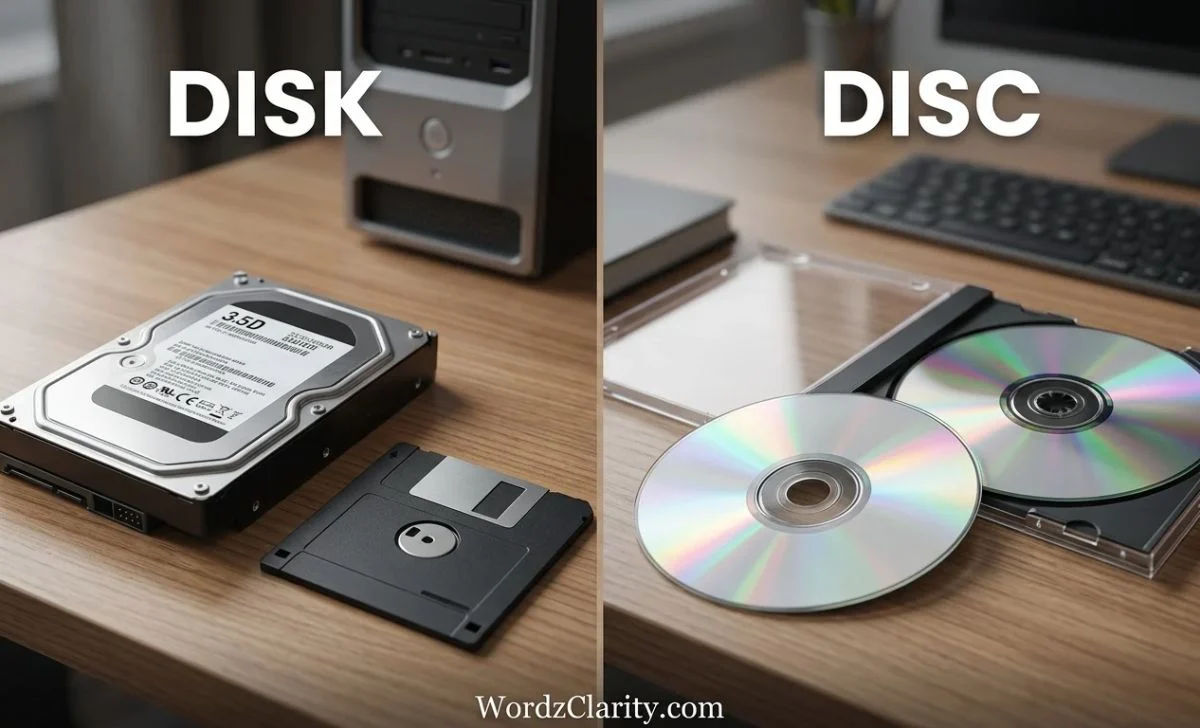
Here is the short answer: both are real spellings of the same word, but each has its own favorite territory. Use disk for computer storage. Use disc for music, movies, and flying toys.
So the tip should say “hard disk.”
This guide shows the rules, the exceptions, and easy tricks, so you can pick the right spelling every time.
Disk or Disc: The Quick Answer
A handy rule from Mental Floss sums it up: if it’s flying, it’s a disc. If it’s floppy, it’s a disk.
- Disk: computer storage, like a hard disk or floppy disk.
- Disc: music, movies, and optical media, like a compact disc or DVD.
There are exceptions. Keep reading for the full list.
Are Disk and Disc the Same Word?
Yes. They share one meaning: a flat, round object.
They also sound the same. You say it as disk in both cases.
The difference lies only in spelling and in what each spelling usually describes. Usage guides do not agree on every case, and there is no neat logic behind it. Each pattern simply became a habit.
When to Use Disk
Use disk for computing and data storage.
Computer Examples
- hard disk
- floppy disk
- disk drive
- disk space
- disk cleanup
- disk partition
- magnetic disk
Example sentences:
- My hard disk is almost full.
- Floppy disks are now obsolete.
- Free up disk space before you install the update.
Operating systems follow this too. Windows uses “Disk Management.” Apple uses “Disk Utility.”
Why Computers Use Disk
In the 1940s, American computer scientists needed a name for their flat storage devices. They chose the “k” spelling. It stuck, and compounds like hard disk and floppy disk became standard.
That is why even British writers use disk for computer storage today.
When to Use Disc
Use disc for media, entertainment, and several physical objects.
Music and Movies
- compact disc (CD)
- DVD
- Blu-ray disc
- disc jockey (DJ)
- disc recording
Example sentences:
- She burned the photos onto a disc.
- The disc jockey played all night.
The music industry has favored the “c” spelling since disc-shaped records became popular in the late 1800s. That is why you hear disc jockey, not “disk jockey.”
Sports and Play
- flying disc
- disc golf
If you are tossing a Frisbee, say flying disc.
Machines and Vehicles
- disc brake
- clutch disc
- disc harrow
Grammarist lists “disc” as the standard spelling for components of plows and brake systems. Example: “The car has ventilated disc brakes in front.”
The Eye
In eye science, the spot where the optic nerve meets the retina is the optic disc. Grammarly notes this is the preferred spelling for eye-related terms.
Disk or Disc in the Spine?
This one has no clear winner.
The cushions between your spinal bones appear in both spellings.
- The Mayo Clinic writes herniated disk.
- The American Association of Neurological Surgeons writes herniated disc.
- The AMA recommends disk for anatomical terms, except in ophthalmology, where it advises disc.
Here is the safe move: follow the style guide or source you are writing for. If you have none, choose one and stay consistent.
British writers often prefer slipped disc.
American English vs British English
Region also plays a role.
- American English leans toward disk for most general round objects.
- British English leans toward disc. The Oxford English Dictionary says disc is now the more usual form in British English, except for computing, where US influence made disk more common.
So a British writer may type “disc brake” and “hard disk” in the same article. That is normal.
Quick Reference: Disk or Disc by Topic
| Topic | Preferred spelling | Examples |
|---|---|---|
| Computer storage | Disk | hard disk, floppy disk, disk drive |
| Music and film | Disc | compact disc, DVD, disc jockey |
| Sports | Disc | flying disc, disc golf |
| Vehicles and machines | Disc | disc brake, clutch disc |
| The eye | Disc | optic disc |
| Spine | Either | herniated disk or disc |
| Space and shapes | Either, often disk | accretion disk |
Tricks to Remember
Trick 1: C for Compact Disc, K for Computer Disk
- Disc is used in compact disc (CD) and Blu-ray Disc.
- Disk is common in computer terms, such as hard disk and floppy disk.
Trick 2: Flying Disc, Floppy Disk
- A flying disc is used in games like disc golf.
- A floppy disk is an old device used to store computer files.
This trick helps you remember the spelling in these two examples.
Trick 3: Ask, “What Is It Used For?”
Think about the object’s purpose.
- For CDs, DVDs, and music discs, use disc.
- For computer storage, such as a hard disk or floppy disk, use disk.
This is a helpful guide, but it is not a strict rule. Some terms use a specific spelling.
Trick 4: Follow the Official Name
Some products and computer tools use a fixed spelling. Keep that spelling when you write their names.
For example:
- Blu-ray Disc
- Disk Utility
- Disk Management
Check the official product name if you are unsure.
Disk, Disc, and Drive: Clearing Up the Tech Terms
People also mix these up.
- Hard disk drive (HDD): a storage device with spinning magnetic disks.
- Solid-state drive (SSD): storage with no spinning parts. People still say “disk space” for it.
- Optical disc: a CD, DVD, or Blu-ray that a laser reads.
- Disk drive: the device that reads or writes a disk.
So you could say, “I copied files from the disc to my hard disk.” One word for the media. One word for the storage.
Where Do the Words Come From?
Both come from the Latin word discus and the Greek diskos, meaning a flat, round object.
The oldest English examples, from the mid-1600s, use disk. The “c” spelling appeared about 50 years later as a learned spelling that echoed the Latin.
For centuries after, writers used both. In general, Americans favored disk, and Britons favored disc.
The Oxford English Dictionary noted in 1896 that disk was the earlier and, in its view, better spelling. Today, dictionaries mostly treat the two as variants.
Real-Life Examples of Disc and Disk
Tech Support
Your startup disk is almost full. Delete old files to make room.
Music Review
The band will release its new disc on Friday.
Car Manual
Replace worn brake discs to keep your car safe.
Sports Club Flyer
Join us for disc golf this weekend.
Common Mistakes to Avoid
- Writing “hard disc.” The standard is hard disk.
- Writing “compact disk.” The standard is compact disc.
- Writing “disk jockey.” The standard is disc jockey.
- Switching spellings in one article. Pick one for each topic and stay consistent.
- Ignoring brand names. Copy official product names exactly.
- Fighting about spinal terms. Both spellings are accepted. Follow your source.
Quick Practice: Disk or Disc?
Fill in the blank. Answers are below.
- My laptop is low on ______ space.
- The DJ spun a vinyl ______.
- The mechanic replaced the front brake ______.
- I backed up the files to an external hard ______.
- We played ______ golf on Saturday.
- She watched the movie on a Blu-ray ______.
Answers: 1. disk. 2. disc. 3. discs. 4. disk. 5. disc. 6. disc.
FAQs
Is it disk or disc?
Both are correct spellings. Use disk for computer storage and disc for music, film, and flying toys.
Is it hard disk or hard disc?
It is hard disk.
Is it compact disc or compact disk?
It is compact disc.
Is it disc brake or disk brake?
It is disc brake.
What is the difference between a disc and a disk?
There is no difference in meaning. The difference is in the spelling convention for each field.
Is it disk jockey or disc jockey?
The standard is disc jockey.
Do British people use disc or disk?
British English prefers disc in general. But computing terms usually use disk.
Is it herniated disk or herniated disc?
Both appear in medical sources. Follow the style of your publication.
Conclusion
The rule of thumb is short. Disk is for computers. Disc is for media and flying things.
When unsure, use the C for Compact, K for Kilobyte trick. And when a product or style guide sets the spelling, follow it.
Now you can write your tech tip with confidence. Your hard disk will thank you.
Read More Blogs
- Alive or Dead: Meaning, Differences, Examples & Quiz
- Suika vs Makuwauri: Taste, Appearance, Origin, Key Differences
- In Process or In Progress: The Simple Rule for Every Situation