If you’ve ever paused before typing address, you’re not alone. Many people accidentally write adress, especially when filling out online forms, writing emails, or entering shipping details.
The confusion usually comes from the double letters. Should there be one d or two? One s or two?
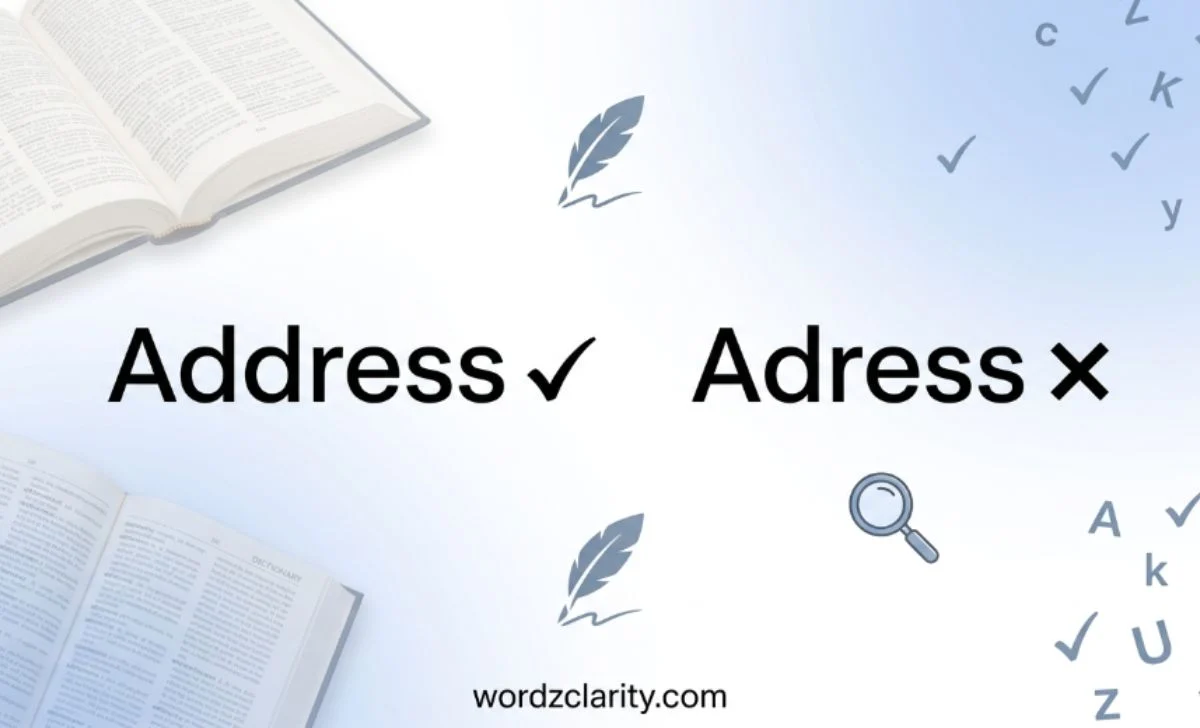
The correct spelling is address. The form adress is a common misspelling and isn’t accepted in standard English.
In this guide, you’ll learn the correct spelling, its meaning, pronunciation, and the simple reason behind the double d and double s.
Address or Adress: Quick Answer
Need a quick answer?
| Spelling | Correct? | Use |
|---|---|---|
| Address | ✅ Yes | Standard English |
| Adress | ❌ No | Incorrect spelling |
Correct: Please confirm your email address.
Incorrect: Please confirm your email adress.
Whether you’re talking about a home location, an email, a website, or speaking to an audience, address is always the correct spelling.
How to Spell and Pronounce Address
The correct spelling is:
Address
It contains:
- Two d’s
- Two s’s
That’s the spelling you’ll find in dictionaries, school textbooks, business documents, and everyday writing.
Pronunciation
IPA (UK & US): /əˈdres/
Simple pronunciation: uh-DRESS
The pronunciation stays the same whether you’re referring to a postal address or using address as a verb, although the verb may receive slightly stronger stress in natural speech.
What Does Address Mean?
One reason this word appears so often is that it has more than one meaning. Depending on the sentence, address can be either a noun or a verb.
Address as a noun
As a noun, address usually refers to information that identifies a place or a way to contact someone.
Common types of addresses
- Home address
- Postal address
- Mailing address
- Business address
- Email address
- Web address (URL)
Examples
- Please write your home address on the application form.
- I changed my email address last month.
- Double-check the shipping address before placing the order.
- Type the website address into your browser.
Although these examples refer to different things, the spelling never changes.
Address as a verb
As a verb, address means to deal with something, speak to someone, or direct words toward a person or group.
Examples
- The manager will address the team after lunch.
- We need to address this issue before the deadline.
- She addressed the audience with confidence.
- The report addresses several important questions.
In professional writing, this meaning is just as common as the noun form.
Why Is It Address and Not Adress?
The short answer is simple:
Address is the accepted spelling in modern English. Adress has never been the standard form.
Many spelling mistakes happen because people naturally simplify double letters while typing. Since English contains words with both single and double consonants, it’s easy to leave one out without noticing.
For example:
- accommodation ❌ often becomes acommodation
- necessary ❌ often becomes neccesary
- address ❌ often becomes adress
That’s why spell checkers frequently flag adress as an error.
Why Does Address Have Two D’s and Two S’s?
There isn’t a separate grammar rule that tells writers to add extra letters to address. The double d and double s are simply part of the word’s standard spelling.
The easiest way to remember it is to learn the word as a complete unit rather than trying to build it letter by letter.
A simple pattern can help:
Address = AD + DRESS
Notice how the word naturally contains:
- AD
- another D
- DRESS
While it’s not the historical origin of the word, this memory trick makes the spelling much easier to recall when writing quickly.
A Brief Look at the Word’s Origin
The word address entered English through French, where it originally referred to directing or guiding something toward a particular place or person. Over time, its meaning expanded.
Today, address is used in several everyday contexts, including:
- Contact information
- Postal and mailing details
- Email communication
- Website URLs
- Public speeches
- Solving problems or discussing important issues
Despite these different meanings, one thing never changes the spelling.
Whether you’re writing an email, entering your delivery details, or preparing a presentation, address is always the correct form. Adress is simply a spelling mistake and should be avoided in both formal and informal writing.
How to Use Address Correctly in Sentences
Once you know the correct spelling, the next step is using it naturally. Here are examples from everyday situations.
Home and postal addresses
- Please write your address clearly on the application form.
- We recently changed our home address.
- The package was delivered to the wrong address.
Email and online accounts
- I forgot my email address password.
- Enter your email address to receive the verification code.
- Make sure your contact address is up to date.
Business and workplace
- The CEO will address employees at tomorrow’s meeting.
- We need to address the customer’s complaint quickly.
- The report addresses the company’s biggest challenges.
Technology
- Copy the website address before sharing the link.
- Check that the web address is correct before logging in.
These examples show that address works naturally as both a noun and a verb.
Common Spelling Mistakes
The most frequent mistake is removing one of the double letters.
| Incorrect | Correct |
|---|---|
| Adress | Address |
| Addres | Address |
| Adres | Address |
| Addresss | Address |
These errors usually happen when typing quickly rather than misunderstanding the meaning.
A quick proofread is often enough to catch them.
Quick Memory Trick
If you often forget the spelling, use this simple reminder:
Address has two D’s and two S’s.
Or think of it like this:
AD + DRESS = ADDRESS
It’s not the word’s historical origin, but it’s an easy way to remember the correct spelling during exams, emails, or everyday writing.
Address vs Adress: Quick Comparison
| Feature | Address | Adress |
|---|---|---|
| Correct spelling | ✅ Yes | ❌ No |
| Standard English | ✅ Yes | ❌ No |
| Found in dictionaries | ✅ Yes | ❌ No |
| Used in formal writing | ✅ Yes | ❌ No |
| Used for email, postal, and web locations | ✅ Yes | ❌ No |
| Can be a noun and a verb | ✅ Yes | ❌ No |
FAQs
Is adress a real English word?
No. Adress is a misspelling. The correct form is address.
Why does address have two d’s and two s’s?
Because that’s the standard spelling of the word in modern English. The double letters are part of the word and should always be included.
Is address a noun or a verb?
Both.
As a noun, it refers to contact or location information.
As a verb, it means to speak to someone or deal with a situation.
What is a web address?
A web address, also called a URL, is the location of a website on the internet.
What’s the difference between a postal address and an email address?
A postal address identifies a physical location where mail is delivered.
An email address identifies an electronic mailbox used to send and receive messages.
Can address be used in formal writing?
Yes. It’s commonly used in business emails, legal documents, academic writing, government forms, and professional communication.
Conclusion
The correct spelling is address, not adress. Whether you’re referring to a home, an email address, a website, or addressing an audience, the spelling stays the same. Remember that the word always contains two d’s and two s’s.
Learning this simple pattern will help you avoid one of the most common spelling mistakes in English and write with greater confidence in school, at work, and in everyday communication.
Read More Blogs:
- 22th vs 22nd: Correct Spelling, Grammar, and Usage Explained
- Website or Web Site: Which Form Is Correct in Modern English?
- Colombian or Columbian: The Mistake Even Native Speakers Make
- Photoshoot or Photo Shoot: Which Spelling Is Correct?